$10 To View Court Documents? 1st Amendment Groups Protesting

You can add First Amendment groups to those upset by budget-crunching changes to the California justice system. They say a new $10 fee just to view court documents limits access to public information. The Judicial Council, the policy guys for the courts, say it’s just a way to fund the system. Peter Scheer of the San Rafael-based First Amendment Coalition, also complains that the change was deep in Gov. Jerry Brown’s budget bill rather than in sponsored legislation – a way to limit opposition.
 
“This will alter and in this case diminish the scope of a personal right of citizenship,” Scheer told the Santa Rosa Press Democrat, which covered the issue this week. “It should not be done by trailer bill in the dark of night.” His voice adds to a growing chorus of discontent as long-promised changes in the court system take effect and as more details of Gov. Brown’s budget come to light.
 
Read the excellent report here

Daily News Offers Good Story On Court Protests

Looking for a good handle on last week’s court protests? Then check out the L.A. Daily News. That’s news too, because the paper has not exactly led coverage on the issue; nothing like marching in the streets to draw the mainstream media. That said, staff writer Christina Villacorte does a good job outlining the issues  of a federal lawsuit, especially the arguments that the court changes violate the Americans with Disabilities Act, or ADA.
 
Villacorte also amplifies growing complaints that the court cuts took place in relative secrecy, reporting that “… The Save Our Courts Coalition, made up of community groups, religious organizations, legal aid providers, labor union and court employees, demanded that the Los Angeles Superior Court cancel the closures, hold public hearings at each of the affected courthouses and find other ways to balance its budget.”
 
A great get-up-to-speed link to send to your non-court-watching friends is right here. 

ADA Is Key To Court Re-Org Lawsuit

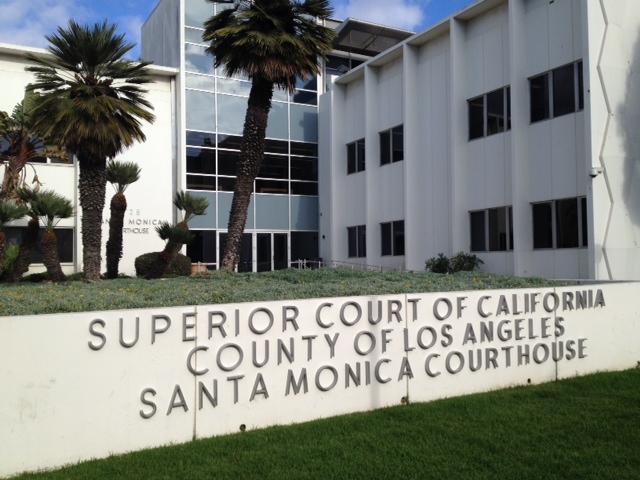
The Americans With Disabilities Act, or ADA, appears to be the heart of that complaint filed against state reorganization of its courts. The federal complaint, filed March 13, makes an argument that under the new system “… there will be no unlawful detainer courtrooms in the San Fernando Valley [so] tenants from the Valley will be forced to travel to either Santa Monica or Pasadena – areas to which there is no adequate public transportation route from the Valley.” Unlawful detainer is the term for eviction actions.
CCM staff photo

CCM staff photo

 
The complaint offers an example of a San Fernando Valley resident who now could access a courthouse six miles away but would have to travel some 30 miles to Santa Monica under the new system. The action, filed by a coalition of non-profits including a low-income housing group, notes that state law offers strict timelines for eviction cases and that lack of transportation might favor the landlords.
 
Read about the issue and access a copy of the full complaint here

Breaking News: Legal Aid Groups Sue L.A. County Over Court Closings

The lawsuits have begun over Los Angeles County’s plan to close courthouses and switch formerly community-based operations to “hubs.” Now a “coalition of legal aid groups” is suing in Federal Court, saying that shutting down those courthouses will deny access to justice. It will be interesting to see how court officials defend that charge since many have been saying the same thing for months.
 
Specifically, some groups feel that moving time-sensitive eviction cases to hubs also violates the state’s obligation to make courts available to people with disabilities. The hubs plan is set to take effect Monday.
 

Listen to a  L.A. public radio report on the breaking story here.

Subtle Warnings As New Court Cuts Loom

Listen with the right kind of hearing and you detect subtle warnings ahead of the next big wave of state civil court cutbacks. For example, when Chief Justice Tani Cantil-Sakauye says, during her State of the Judiciary address no less, that California, “normally a leader in social justice, may now be facing a civil rights crisis,” you can bet somebody is drafting arguments. 
 
Chief Justice Tani Cantil-Sakauye (Photo: California Courts)

Chief Justice Tani Cantil-Sakauye (Photo: California Courts)

The “civil rights” issue has always been king of criminal courts, of course, and an array of rulings and legislation govern how much the state can cut in that realm. That’s why most of the court cutback anguish is coming to fee-collecting civil courts. But you see the next argument when the Chief Justice says budget cuts have brought “… unconscionable delays” in getting a court date in civil matters, including divorce, contract disputes and discrimination cases. The first two are one thing, the later is another and hints at the civil rights argument.
 
Many of the real court cuts are due in the April/May window in front of June fiscal deadlines. So you can look for a big-time increase in rhetoric; our guess is the over/under for lawsuits against the civil court cuts is down to 45 days. Read between the lines in the L.A. Times here.

Low-Income Tenants Face Harm In State Budget Cuts

You can add “low-income tenants” fighting eviction among those being disproportionately harmed by the Los Angeles County Superior Court reaction to state funding cuts that will cause a massive reorganization of the justice system. The impact will come from reducing how many courts handle landlord disputes: From 26 to five.

That means long travel times and the Los Angeles Times notes that in some cases that will mean a 32-mile journey. For some, the paper reports, “… the trips could take several hours using public transportation and include transfers on multiple trains and buses.” The paper quotes Neal Dudovitz, executive director of Neighborhood Legal Services of Los Angeles County, who also noted that he travel time is of particular concern in eviction cases because the courts move quickly, he said.

See the full story in the LA Times. 


It’s Getting Real: Courts Begin Shifting Cases Away From Communities

The dismantling of Los Angeles County’s once-praised community court-access system is getting under way, with small claims cases filed at the Torrance courthouse being handled in Inglewood and many personal injury cases, perhaps thousands of them, being moved from local courts to the Stanley Mosk Courthouse in downtown L.A.
 
The Daily Breeze newspaper is among those documenting the shift. “We do not take these actions likely,” Torrance Superior Court Judge Stuart Rice told the Daily Breeze. “They break our heart, but for the lack of funding this would not be happening.” Under the county court plan to create “hubs” where cases are heard, collections matters will be scheduled in the Chatsworth and Norwalk courthouses, and South Bay landlord-tenant disputes will be set for the Long Beach courthouse.
 
Read about these and other major shifts in the paper’s story here.

Stronger Rhetoric Used In Courts Funding Crisis

The usually judicious advocates for increasing funding to California courts are using increasingly heated terms for the situation, with the state’s Chief Justice getting a lot of Internet buzz after saying the results will be “… the dismemberment of the judicial branch.” And chief justice Tani Cantil-Sakauye was not addressing some obscure civic group but the high-profile Public Policy Institute.
 
In published reports, she said that: “In the last five years, $1 billion has been taken from the judicial branch… according to the latest proposed budget, it looks like the judicial branch will receive one penny of every dollar of the General Fund, which is an incredible bargain for what we provide. So we do that without raises and without broadening our scope and without more judges… all the while our caseload remains the same. We continue to provide a forum for justice on an ever-shrinking, minuscule slice of the pie. For California, it means disparate access to justice, and in some it means no access to justice.”
 
San Bernardino County continues to be a poster child of the cutbacks. The chief justice explained that a San Bernardino resident, to get his or her day in court, has to travel 175 miles one way; you have to assume they have transportation, that they can leave work to spend the day in court. Then they have a 175-mile trip back.

Link to the report in The Courthouse News here.

County Jails Strain to ‘Balance’ State Budget

 Another way to get to a “balanced” state budget? Shift prison costs to county jails. And a new Associated Press report documents that California counties are now housing more than 1,000 inmates with sentences of a year or more that would have been in state facilities before Gov. Brown’s new policies.
 
The state’s sheriff’s association is pushing back, noting that costs are not just for housing but recreation, health care and education formerly provided by the state. And the L.A. County Jail is holding 35 percent of those long-term prisoners, many for violent crimes and/or drug convictions. Along with other agencies, you can add this to the trend of local officials pushing back against state cuts that only shift costs to county and municipal jurisdictions.
 
See the story here.
 
Sheriffs also must provide the inmates with education, treatment programs, rehabilitation services and recreation, which adds to their costs. – See more here.

Counties Begin Push For Courts Funding

In the wake of state legislative hearings on budget cuts hitting California courts, counties are starting to formally push back. One example is the San Bernardino County supervisors adopting a resolution to support efforts to increase funding. It’s a good example, because the county has long been considered under-funded for courts and has documented its lower-than-average number of judges. It also faces closing courts in communities like Big Bear and Needles at the same time mass transit cutbacks will limit resident access to other courts.
 
Officials from SB County who testified to state lawmakers in Sacramento recently said those meetings were “productive.” See more details about their testimony and situation here.
 
The San Bernardino County Board of Supervisors are expected to vote Tuesday on a resolution supporting efforts to adequately fund county courts. See more here