‘Border Kids’ Moves Into New ‘Crisis Of Process’

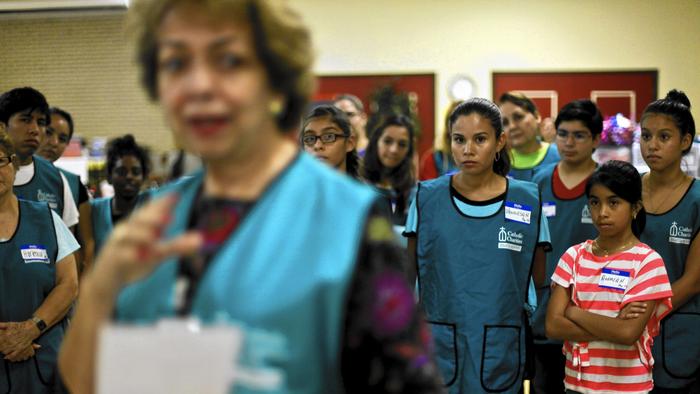
Photo from the LA Times Report, "7,000 immigrant children ordered deported without going to court," 3/6/15

Photo from the LA Times Report, “7,000 immigrant children ordered deported without going to court,” 3/6/15


Just when you think the “Border Kids” crisis where thousands of minor asylum seekers flood the borders, the situation takes a turn for the worse. Now, the Los Angeles Times reports, “… more than 7,000 immigrant children have been ordered deported without appearing in court since large numbers of minors from Central America began illegally crossing the U.S. border in 2013, federal statistics show.”
 
Not that anyone knows much beyond those orders. The Times notes that immigrant advocates say many of those children were never notified of their hearing date because of problems with the immigration court system. Times sources say that some notices arrived late, some went to the wrong address or perhaps there was no notice delivered at all. Those sources also say some children were ordered to appear in a court where they were initially detained, not where they are living now.
 
Also, nobody really knows how many of those children choose to just not show up for the hearing, or how many were actually notices. “What was a border crisis has now become a due process crisis,” said Wendy Young, president of Kids in Need of Defense, an advocacy group, in the Times report. Oh, and it is also not known how many of those children facing deportation orders have been sent home – you have to wonder if they even know the hearings happened.
 
Read more on the mess at the Times.


NPR Follow-Up Humanizes Those Border Kids Cases

As the United States punts on its obligation to deal with asylum seeking children on its southern border, a new NPR report follows up on the story of  Jose, no last name or country used for fear of gang retaliation, who is “… one of almost 60,000 unaccompanied minors from Central America now living with family and friends in the United States. Most of the youths are awaiting court hearings to determine whether or not they can stay in the country. Many are also going to school and trying to get settled in new homes and new communities.”
 
NPR says that “a recent study by Syracuse University found that two-thirds of unaccompanied minors do not have legal representation — and that having it makes a big difference; those with attorneys are far more likely to be allowed to stay in the United States.”
 
As we have noted before, immigration courts have the look and feel of regular courts, but are actually civil proceedings and the judges are actually Justice Department employees In effect, the “courts” are hearings and NPR quotes one legal-services activist saying “… these kids are facing exile and in some cases death. It’s also very hard to represent yourself pro se when you’re a 10-year-old in a new country and you don’t speak the language.”
 

Church-Based ‘Guardian Angels” Step Into Help ‘Border Kids’ Facing Deportation

A Los Angeles Times report highlights efforts of a Lutheran church group becoming de facto court watchers to make sure the “border kids” – those under-18 would-be immigrants from countries other than Mexico who recently flooded into the U.S. – understand their rights under American law. Advocates say the Justice Department courts that review cases are wildly uneven and outcomes depend largely on legal representation. Those charged in the courts do not have a right to an attorney because the cases are considered civil actions.
 
Reports the LAT: “Because the government does not provide lawyers to immigrants facing removal, many of the children have ended up navigating complex deportation proceedings alone. Last fiscal year, 72% of children in deportation hearings were not represented by an attorney, according to federal data analyzed by Syracuse University’s Transactional Records Access Clearinghouse.”
 
Leaders of the guardian angels program, notes the Times, include the Lutheran pastor “… who hatched the idea last summer after hearing that children’s deportation hearings were being fast-tracked through the court system. More than three-fourths of children’s court cases closed in the second half of last year resulted in removal orders, according to the federal Executive Office of Immigrant Review. In the vast majority of those cases, the deportation orders were issued in absentia because the children did not show up for their hearings.”
 

Judges Renew Calls For Immigration Court Reform

After a period of relative quiet, the immigration judges facing hundreds of thousands of cases are speaking out, calling for help amid a crisis. A new NPR report explains that “… as Congress debates the fate of President Obama’s immigration policies, the nation’s immigration court system is bogged down in delays exacerbated by the flood of unaccompanied minors who crossed the southern border last summer. The administration made it a priority for those cases to be heard immediately. As a result, hundreds of thousands of other cases have been delayed until as late as 2019.”
 
NPR adds that “even before this past summer’s surge of unaccompanied minors seeking asylum, the immigration courts were already clogged, says Judge Dana Leigh Marks, president of the National Association of Immigration Judges. There were too many cases for too few judges, and adding in the cases of the unaccompanied minors only made matters worse. There are currently more than 429,000 cases pending in the courts with just 223 judges.
 
The “judges” are not part of the usual judicial system, but are actually employees of the Justice Department – that means, for example, that they could not hold government agents – really, their co-workers – in contempt of court during one of the hearings. Read more: Immigration Courts ‘Operating In Crisis Mode,’ Judges Say

Judge Halts Obama’s Immigration Order

When President Obama took executive action on immigration policy, one concern was that legal action would delay or even halt his plans. That’s come to pass, with a federal judge in Texas blocking the action to give a 26-state coalition more time to pursue its lawsuit against the measures. The White House says it will appeal, but such is the danger of congressional inaction – we head to the executive branch and, eventually, the courts.
 
In response to the judge’s order, the U.S. Department of Homeland Security said it would halt preparations for a program to protect parents of U.S. citizens or legal permanent residents until further notice.
 
Read the Associated Press report here

NYT Publishes Game-Changer On Family Detention

The New York Times Magazine has published what might become a game-changer in the immigration courts crisis. Under the headline “The Shame of America’s Family Detention Camps,” the piece by Wil S. Hylton offers background that “…since the economic collapse of 2008, the number of undocumented immigrants coming from Mexico has plunged, while a surge of violence in Central America has brought a wave of migrants from Honduras, El Salvador and Guatemala. According to recent statistics from the Department of Homeland Security, the number of refugees fleeing Central America has doubled in the past year alone — with more than 61,000 “family units” crossing the U.S. border, as well as 51,000 unaccompanied children. For the first time, more people are coming to the United States from those countries than from Mexico, and they are coming not just for opportunity but for survival.”
 
He also notes that the Obama administration reversed its policy when the crisis hit, to a “draconian” approach. And the human and public policy misery that followed. It’s a milestone story in the history of U.S. family detention:
  

Thousands Of Immigration Cases Delayed Until At Least 2019

The Dallas Morning News is reporting that “… thousands of immigrants seeking legalization through the U.S. court system have had their hearings canceled and are being told by the government that it may be 2019 or later before their futures are resolved.” The paper says that “… immigration lawyers in cities that absorbed a large share of those cases, including New York, San Antonio, Los Angeles and Denver, say they’ve had hearings canceled with little notice and received no new court dates. Work permits, green cards, asylum claims, and family reunifications hang in the balance.”
 
By way of background, the cancellations began began to skyrocket over the summer as the Justice Department prioritized the tens of thousands of Central American migrants crossing the U.S.-Mexico border, most of them mothers with children and the high-profile arrival of unaccompanied minors.
 
The Dallas newspaper report quotes David Martin, a law professor at the University of Virginia who worked for two Democratic presidents, who “criticized Congress and the Obama administration for not funding more immigration judges.” He also told the paper that “… you fund more investigators, more detention space, more border patrol, almost all of these are going to produce some kind of immigration court case… you are putting a lot more people into the system. It’s just going to be a big bottleneck unless you increase the size of that pipeline.” Read the story here.

California Groups Demand ‘Trust’ Implementation

Across the Golden State protestors this week are asking state officials to fully implement a 2014 law that protects undocumented immigrants reporting crimes or becoming witnesses to wrongdoing. The “Trust Act” was aimed at allowing those immigrants to testify in court or report crime without fear of deportation, but activists say it has not been followed.
 
The NBC affiliate in San Diego covered protests there and explained that “… the law decreased immigration “holds” in California, which in turn decreased deportations of undocumented immigrants. The law also provided expanded protections for undocumented immigrants. Protesters claim law enforcement officers have violated the state law instead of implementing it.” The immigration holds are actually civil actions, not criminal, so they do not always include safeguards like legal representation.
 
Watch the NBC 7 San Diego video coverage:


Central American Cases Push Others Aside

One way to respond to the immigration courts crisis highlighted by those unaccompanied minors from Central America would be to overhaul the system and increase capacity. Another would be to push those cases ahead of others in hopes of discouraging other migrants from coming. Guess which one we’re doing? 
 
The Houston Chronicle has a strong story about “… a startling turnaround for a clogged immigration court system that usually takes about six months between just these first steps [as opposed to 30 days], reflecting the government’s effort to push Central American cases through the pipeline to deter other migrants from coming. The aggressive effort, however, has ramifications for others in the system, which is facing a record backlog of more than 430,000 cases nationwide. Some immigrants’ hearings have been delayed indefinitely, which can impede time-sensitive cases and jeopardize their chances of gaining legal residency. Mexicans, who make up the largest portion of immigration courts’ caseload, saw their disposition times increase by about 13 percent to 533 days, according to a new analysis of court records by Syracuse University’s Transactional Records Access Clearinghouse.”
 
“The Central American cases have completely taken over the docket,” immigration attorney Salvador Colon told the paper, while another noted that “they’re shoving all the Central Americans in front saying, ‘Go home and tell everyone else not to come because you’re going to be deported. The immigration court here looks like a day care because there are so many little kids hopping around.”
 

In First, 2014 ‘OTM’ Out-Paced Mexican Immigrant Detention

For the first time, the OTM, or “other than Mexican,” immigration out-paced Mexican nationals apprehended at the U.S. Mexico during 2014, a Texas ABC News affiliate is reporting. Citing a Pew Research Center study, KRGV in the Rio Grande valley says that “… [in] 2014, the number of Mexican nationals detained was 229,000, compare to nearly 260,000 OTMs. A surge of Central American children made up a large part of the immigration picture last summer. The numbers are lower than in years past, but the open border raises many questions nationally and locally.”
 
The OTM designation offers a different path for would-be migrants, including an immigration court review before they can be sent back. The bigger numbers come as the U.S. faced a surge from Central American companies, especially among minor children seeking refuge here. The TV station speculates that “… it is possible immigration courts will be busy with thousands of people filing documents. In the next few weeks, it is possible those same courts will likely handle hundreds, possibly thousands, of cases involving new illegal immigrants.” The story outlines border issues involving social services, property insurance and other impacts. See it here.