New Delays Loom As Court Interpreters Seek New Deal

Less than 15 percent of U.S. Immigration Court proceedings are conducted entirely in English, meaning that interpreters are vital to getting things done. Now, already facing more than 450,000 cases backlogged for years, the immigration justice system may lose many of those language assets. BuzzFeed News is reporting that “… interpreters across the country are refusing to sign on to a new contract to service U.S. immigration courts, citing what they call unacceptably low pay and poor working conditions.
 
The background in the report: “Immigration courts are part of the executive branch and administered by the Department of Justice. DoJ uses a combination of 67 staff and 1,650 freelance interpreters to ensure that immigrants facing deportation understand the proceedings against them. In July, the Justice Department switched contractors, awarding a new contract for more than $12 million annually to SOSi, according to a database of federal contracts. The contract can be extended five years for a total of about $58 million.
 
“The contract was initially slated to kick in on September 21, according to DOJ. However, emails to the interpreters from from Lionbridge, the company that currently holds the contract, state that the switch had been deferred to November. Interpreters around the country refused to agree to SOSi’s terms under the new contract because of low pay and ungenerous travel reimbursement and cancellation policies, according to several interpreters interviewed by BuzzFeed News. Because the interpreters are organizing informally, the precise number refusing to sign on is unclear. However, two interpreters in different regions told BuzzFeed News they were each in direct contact with more than 100 interpreters who had refused. On any given day, there are about 300 contract interpreters working for the immigration courts, according to a spokesperson for the courts. That means that about a third of interpreters could be unavailable once the new contract kicks in.”
 

NY Mayor Predicts Legal Right To Civil Lawyers

The Wall Street Journal reported (9/29/15) that New York Mayor Bill de Blasio sees "a day not too far away when indigent defendants have a legal right to a lawyer in civil cases."

The Wall Street Journal reported (9/29/15) that New York Mayor Bill de Blasio sees “a day not too far away when indigent defendants have a legal right to a lawyer in civil cases.”

He admits that local jurisdictions will need federal help to make it happen, but New York City Mayor Bill de Blasio is predicting that he can “see the day” when indigent defendants have a legal right to a lawyer in civil cases. The mayor was speaking at one of  a series of hearings led by New York’s chief appeals judge on the topic of civil legal services. His comments illustrate that New York continues to lead the nation in providing civil attorneys for life-changing cases like eviction and child custody disputes.
 
The Wall Street Journal is among those reporting on the civil Gideon effort, backgrounding that “… in the landmark 1963 case Gideon v. Wainwright, the Supreme Court recognized an indigent defendant’s right to an attorney in a criminal trial. But the high court has never extended the Sixth Amendment’s guarantee of counsel to civil cases. The story quotes New York State Court of Appeals Chief Judge Jonathan Lippman, who has led the conversation: “We are talking about the necessities, or essentials, of life… we mean the roof over someone’s head, we mean their physical safety, their livelihoods, the well-being of their families, entitlement issues.”
 

AZ Case Shows How Little Border Patrol Fears Courts

Anyone looking for an example of Border Patrol officials basically ignoring the U.S. courts might check out a southern Arizona case. Migrants there have long complained about dirty and overcrowded cells, explains the Arizona Republic newspaper, and about being held in frigid cells deprived of adequate food and water, not to mention denied medical care. The ACLU and other groups sued, and the Republic explains that “… a federal judge then ordered the Border Patrol to save all video surveillance tapes dating back to June 10 at the eight holding facilities in the Tucson sector, one of the nation’s busiest, in response to a request from the ACLU seeking evidence to prove its case.”

But it turns out the Border Patrol has since “willfully” destroyed video recordings in direct violation of U.S. District Court Judge David C. Bury’s order, the newspaper says. Government officials say it was a technical problem. The judge issued sanctions (no doubt strongly worded!) but otherwise there seem few consequences to defying the court.” See the story here.

Most Immigration Judges Can Retire Now If They Want

With a Sept. 30 deadline passed, more than half of the United States 247 immigration judges, staffing 58 courts nationwide, are eligible to retire. This as the nation faces an immigration courts backlog of more than 450,000 cases. The Los Angeles Times offers a truly alarming look at the situation, starting with outlining that some judges – who are not actually federal judges but employees of the Justice Department – preside over thousands of cases.
 
The LAT also notes that “… the U.S. attorney general appoints immigration judges. Officials have already started ‘an aggressive hiring process,’ said Kathryn Mattingly, an immigration court spokeswoman. They have hired 18 judges, five more will start this fiscal year, and they plan to hire an additional 67, she said. Last fiscal year, about 100 judges were eligible to retire, but only 13 did, she said.” But the paper quotes current judges lamenting how much more difficult working conditions have become.
 

VICE News Looking Hard At Migrant Family Lockups

The VICE media network has made a living off covering stories under-reported by mainstream (or, more accurately, “more mainstream”) media, and it is focusing on American jails this week. Mostly that is going to involve criminal lockups, but the VICE News is reporting on the family lockups facing a federal judge’s order to release families – and how the government is likely to work around that order.
 
The report notes what other have missed: “With tens of thousands of migrants flooding into Europe in recent months, it’s easy to forget that the US faced its own refugee crisis last summer when scores of children and mothers bolted from Central America amid heightened gang and drug violence. Desperate for a safe haven, the families mounted buses and trains through Mexico and then poured across the Texas border, seeking political asylum.” To that we would add: Last summer? How about now?
 
VICE gives some context: “… to combat the influx, the Department of Homeland Security (DHS) launched an “aggressive deterrence” strategy last July designed to discourage more people from coming. The solution, DHS Secretary Jeh Johnson announced, was to lock up Central American moms and kids as they fought their asylum cases in court. Previously, DHS did not detain such families, but rather allowed them to pay a small bond as an assurance they would show up to their court dates.
 
The new DHS strategy spawned a massive, long-term family detention system for Central American people seeking asylum in the US. The agency contracted the nation’s two biggest private prison companies to open facilities in southern Texas that hold about 3,000 people combined and cost taxpayers hundreds of millions of dollars to operate. Many families have spent seven or eight months in detention while awaiting their day in court.”
 
Check out what very likely is going to happen next here.

What Should We Call Those Migrant Refugee Immigrants Seeking Asylum?

Words matter, and the U.S. media has been struggling to settle on what to call all those folks seeking to leave a very bad place in hopes of a better life. Actually, that would not qualify for “refugee” status, which requires a human to be fleeing war zones or natural disasters. Migrant is a wider net, but loses some of the urgency. “Immigration” carries its own weight. Those seeking asylum, with those political overtones, are yet another situation.

The NPR ombudsman offered an on-air outline of how that standards-leading group approaches the wording. The one thing that seems clear is that just leaving a place because it sucks does not gain the benefits of other status.

See the report here: ‘Refugee’ Or ‘Migrant’: How To Refer To Those Fleeing Home

US Increases Cap On Accepting Refugees

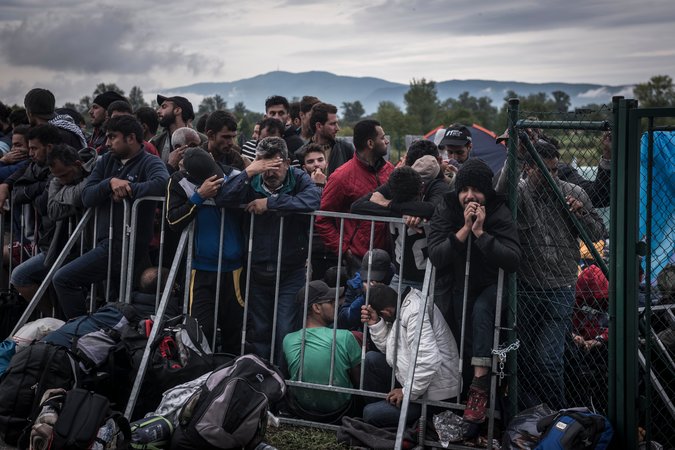
Photo from The New York Times 9/21 article. They report "Migrants in Bregana, Croatia, near the border with Slovenia. Authorities in Slovenia on Sunday were halting migrants at its border with Croatia to the south and allowing them to pass in small groups."

Photo from The New York Times 9/21 article. They report “Migrants in Bregana, Croatia, near the border with Slovenia. Authorities in Slovenia on Sunday were halting migrants at its border with Croatia to the south and allowing them to pass in small groups.”

Secretary of State John Kerry, speaking in Germany, announced that the United States will increase the number of “worldwide” refugees it will accept until it reaches 100,00 per year in 2017. That is up from the current annual cap of 70,000. The move is in reaction to the high-profile crisis involving European migration and there was no conversation about how the than 400,000 pending immigration cases, many of which involve refugee status claims, might be effected.
 

Civil Rights Report Blasts Family Detention Centers For Asylum Seekers

A new report released last week by the U.S. Commission on Civil Rights, added to the complaints about the U.S. government’s family detention centers that house asylum seekers who entered the country illegally. Reuters is reporting that the group said it found evidence that the federal government “was interfering with the constitutional rights afforded to detained immigrants,” including their access to legal representation.
Reuters offers context: “… a year ago, President Barack Obama responded to a ‘humanitarian crisis’ unfolding on the U.S. southwestern border with Mexico, as tens of thousands of children – some traveling with parents and others alone – arrived from El Salvador, Guatemala and Honduras. Among steps he took were a rapid expansion of detention facilities for migrant women and children. It marked a departure from previous practices of largely tracking the immigrants with electronic ankle bracelets and telephone check-ins, which immigration rights groups argued were effective and far less costly.”
Meanwhile, a federal judge in California has ordered the government to close the facilities because they violate a longstanding agreement on how such asylum seekers will be treated. See that story in the L.A. Times here.

NYT Notes ‘Border Kid’ Crisis Is Not Over, But Has Moved

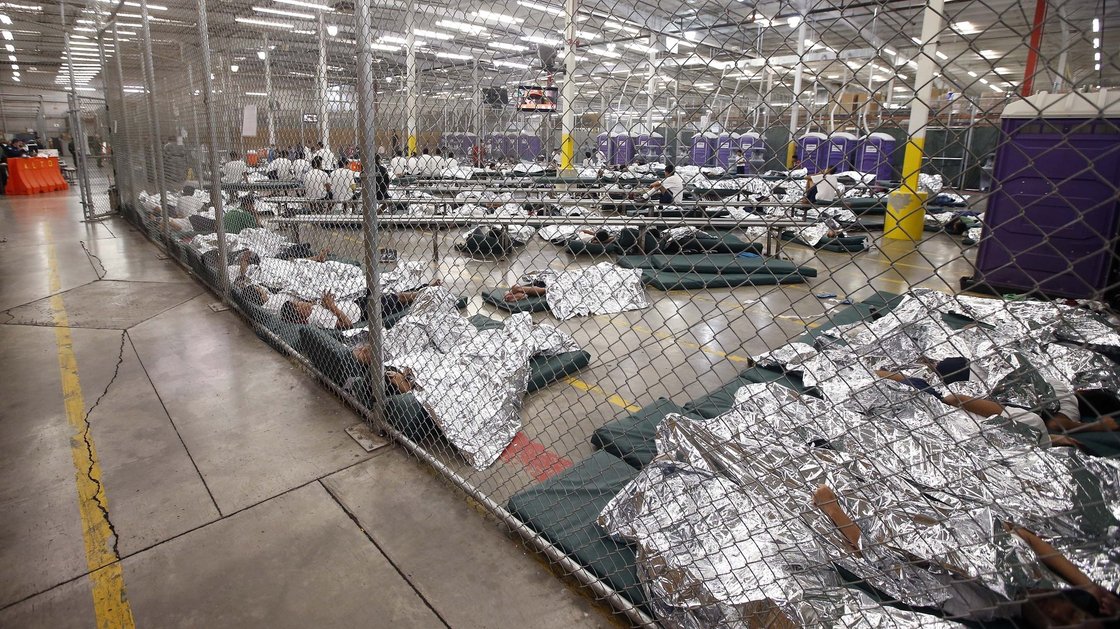
As reported by NPR: Detainees sleep and watch television in a holding cell where hundreds of mostly Central American immigrant children are being processed at a U.S. Customs facility in Nogales, Texas.

As reported by NPR: Detainees sleep and watch television in a holding cell where hundreds of mostly Central American immigrant children are being processed at a U.S. Customs facility in Nogales, Texas.

The New York Times has an important story about the “Border Kids” who arrived in the country amid headlines last summer. The paper notes that the number of kids has dropped, but the crisis has moved to courts. Meanwhile, a federal judge in California has given the U.S. government mere weeks to shut down several “family detention” centers because they are illegal.
 
On the court crisis, the NYT backgrounder is that “… about 84,000 children were apprehended at the Southwest border during the 2014 fiscal year and the first six months of the 2015 fiscal year, according to the Border Patrol. Of the 79,088 removal cases initiated by the government, 15,207 children had been ordered deported as of June, according to the Migration Policy Institute, a nonpartisan research group in Washington.
 
“While a small percentage of children have been granted asylum, most are seeking relief from deportation by applying for special immigrant juvenile status, federal officials said. And yet, rather than their claims being expedited, 69 percent of the children on the priority docket still have cases pending, statistics show.
 
“The burden is far more difficult for children if they do not have a lawyer — a right not granted to defendants in immigration courts — especially because of the accelerated time frame the government established for their cases. After being released to a sponsor, usually a relative, they are on the clock: They are required to make their first court appearance within 21 days of the court’s receiving their case to contest their deportation.”
 
Read the excellent report here: Immigration Crisis Shifts From Border to Courts
 
For a refresher on the Family Detention Center, check out our late August blogs, “Obama Admin. Fighting To Keep Family Detention Centers” and “Judge Orders Govt. To Release Detained Kids.”

Focus Is On Europe’s Refugee Crisis While Similar U.S. Crisis Lingers

Likely Democratic presidential nominee Hillary Clinton is coming out strong on the European refugee crisis, with The Boston Globe reporting she says it calls for  “… an international effort to assist the migrants should be coordinated by the United Nations. She praised Pope Francis, who has called on all Catholic parishes and religious communities to welcome in the migrants.
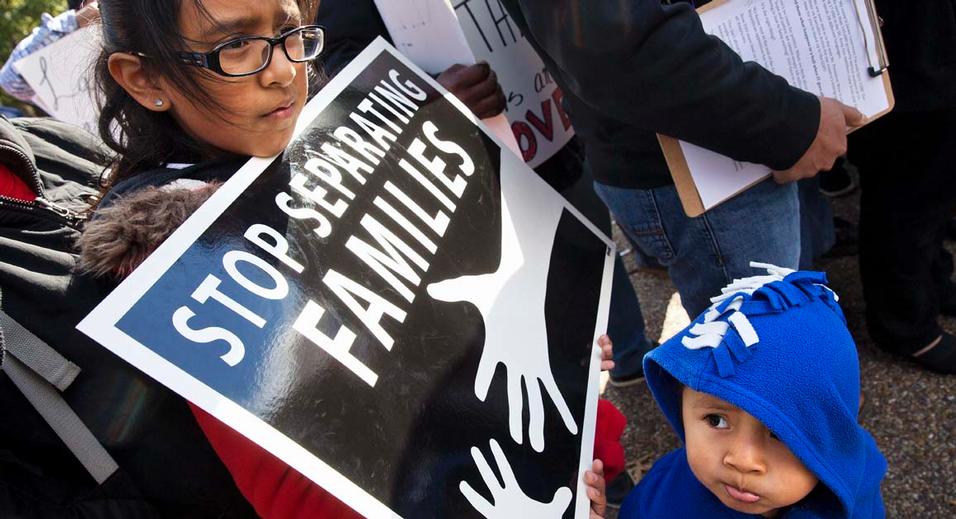
As reported in Politico on 8/7/15: US citizens Esmeralda Tepetate, 10, with her brother Sebastian, 2, whose parents are originally from Mexico, holds a sign that says "stop separating families" during a rally for comprehensive immigration reform, Friday, Nov. 7, 2014,  outside of the White House in Washington. After the midterm elections immigration groups are pushing for executive action. (AP Photo/Jacquelyn Martin)

As reported in Politico on 8/7/15: US citizens Esmeralda Tepetate, 10, with her brother Sebastian, 2, whose parents are originally from Mexico, holds a sign that says “stop separating families” during a rally for comprehensive immigration reform, Friday, Nov. 7, 2014, outside of the White House in Washington. After the midterm elections immigration groups are pushing for executive action. (AP Photo/Jacquelyn Martin)

 
‘‘The whole world has to take some responsibility,’’ Clinton said. Meanwhile a federal judge in California has found our family detention centers illegal and ordered the mothers and children held there released by October 23
 
And that is a separate issue from the more than 400,000 immigration cases backlogged in the U.S. system that includes tens of thousands of refugee-status cases. So, with all due respect, the refugee crisis is not limited to Europe.