New Report Laments San Bernardino Court Situation

Even in a state where court budget shortfalls have created years-long waits for civil trials and closed more than 50 courthouses, the situation in San Bernardino County remains particularly harsh. Now a new report, just in time for state budget season, is detailing just how harsh.
 
The Daily Press in Victorville reports that, “… for starters, the county is facing a $62.7 million funding gap for 2015, meaning that its missing 46 percent of the $137.8 million that was calculated to be needed per workload-based allocation, according to a report March 25 by the state’s Judicial Branch.”
 
The report also notes that “… since fiscal year 2007, San Bernardino County courthouses in Twin Peaks, Redlands, Chino, Needles and Big Bear have closed. A courtroom in Joshua Tree was also shuttered in fiscal year 2007.”
 
It’s a solid reminder that years of cuts have left many judicial systems in shambles. Read about one of those systems here.
Civil Court Rationing Reaches Vermont

You can add Vermont to the list of states feeling the rationing pinch for court budgets, and like California two years ago and the rest of the country over time the civil courts are feeling the most pressure. The Vermont Association of Justice, a stakeholder group, wrote a letter to lawmakers outlining the challenge and noting that”… while abuse and other cases take priority, civil cases remain unresolved. Under the current conditions, attorneys warn clients that it will likely take 18 to 26 months before a judge hears a two-day civil jury trial. It may take as long as four months to schedule a three-hour-long case.”

A courts advocate offered this example: If an injured person is pursuing a case against a national insurance company, the insurance company can afford to wait. The injured person, however, is more likely to need the money sooner to pay for medical bills or other expenses. Instead of waiting for a court time, the insured person may agree to settle for less than their claim is worth.

Meanwhile, civil court delays are expected to get worse.

Read more here.

Judge: 2-Year Waits Triple In Budget-Cut Courts

The number of Los Angeles County civil cases facing delays of more than two years has tripled in the wake of budget cuts, according to Carolyn Kuhl, Los Angeles Superior Court’s presiding judge, She also tells NPR station KQED that “.. L.A. made 10 percent across-the-board cuts to court services in 2012, but it wasn’t enough. So the next year, they made further cuts. In all, 79 courtrooms were shuttered, limiting where people can contest traffic tickets or adjudicate small claims cases. The court has also cut mediation services and eliminated court reporters in civil cases.”

Kuhl noted that “… the setbacks are especially disheartening because she and others have worked for decades to shorten the amount of time it takes to resolve civil cases… and to see those gains essentially be lost — as we now have delays such that the number of cases pending over two years has tripled — is very discouraging.”

The judge’s comments are part of increased media coverage as the state budget process nears its annual decision-making point. Read the story here.

Driving Issue: 131K Licenses Issued To Undocumented In California

Citing state officials, Reuters is reporting that California issued “about 131,000 driver’s licenses to undocumented immigrants in January and February, the first two months since the state began granting the permits to people who are in the country illegally.”
 
The news services added that “the most populous U.S. state joined nine others and the District of Columbia in granting licenses to drivers regardless of immigration status, a controversial move that marked a significant shift in policy toward immigrants in California.” The lack of a driver’s license has long been a problem in the Golden State, prompting some cities to issue their own forms of ID.
 
Between 2 million and 3 million unauthorized immigrants are believed to live in California, making them the nation’s largest such population. Immigration courts, meanwhile, face a backup of some 400,000 cases. Such cases are civil, not criminal, proceedings. To read more about the driving issue, click here.

‘Border Kids’ Moves Into New ‘Crisis Of Process’

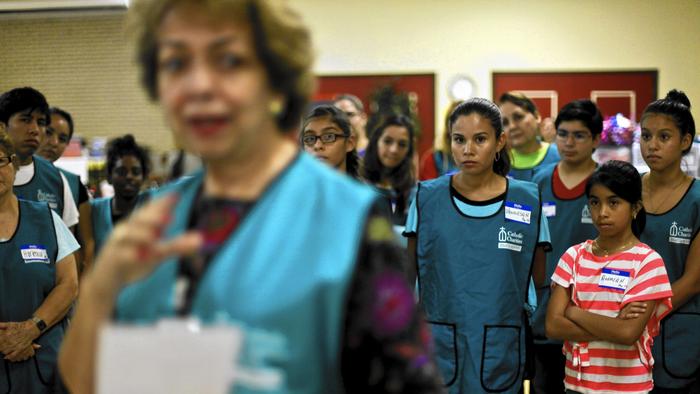
Photo from the LA Times Report, "7,000 immigrant children ordered deported without going to court," 3/6/15

Photo from the LA Times Report, “7,000 immigrant children ordered deported without going to court,” 3/6/15


Just when you think the “Border Kids” crisis where thousands of minor asylum seekers flood the borders, the situation takes a turn for the worse. Now, the Los Angeles Times reports, “… more than 7,000 immigrant children have been ordered deported without appearing in court since large numbers of minors from Central America began illegally crossing the U.S. border in 2013, federal statistics show.”
 
Not that anyone knows much beyond those orders. The Times notes that immigrant advocates say many of those children were never notified of their hearing date because of problems with the immigration court system. Times sources say that some notices arrived late, some went to the wrong address or perhaps there was no notice delivered at all. Those sources also say some children were ordered to appear in a court where they were initially detained, not where they are living now.
 
Also, nobody really knows how many of those children choose to just not show up for the hearing, or how many were actually notices. “What was a border crisis has now become a due process crisis,” said Wendy Young, president of Kids in Need of Defense, an advocacy group, in the Times report. Oh, and it is also not known how many of those children facing deportation orders have been sent home – you have to wonder if they even know the hearings happened.
 
Read more on the mess at the Times.


NPR Follow-Up Humanizes Those Border Kids Cases

As the United States punts on its obligation to deal with asylum seeking children on its southern border, a new NPR report follows up on the story of  Jose, no last name or country used for fear of gang retaliation, who is “… one of almost 60,000 unaccompanied minors from Central America now living with family and friends in the United States. Most of the youths are awaiting court hearings to determine whether or not they can stay in the country. Many are also going to school and trying to get settled in new homes and new communities.”
 
NPR says that “a recent study by Syracuse University found that two-thirds of unaccompanied minors do not have legal representation — and that having it makes a big difference; those with attorneys are far more likely to be allowed to stay in the United States.”
 
As we have noted before, immigration courts have the look and feel of regular courts, but are actually civil proceedings and the judges are actually Justice Department employees In effect, the “courts” are hearings and NPR quotes one legal-services activist saying “… these kids are facing exile and in some cases death. It’s also very hard to represent yourself pro se when you’re a 10-year-old in a new country and you don’t speak the language.”
 

Compton Mayor, Justice Issues Profiled In HuffPo piece

Courts Monitor Publisher Sara Warner has published a Huffington Post profile on Compton Mayor Aja Brown, drawing from a Time Magazine profile last year and an exclusive interview with the mayor. You can read it here: In California’s ‘Hip Hop City,’ Mayor Looks ‘Beyond Brooklyn’

New Courts Director Targets Pension Reform

That state auditor’s report illustrating free-spending ways for
California’s top courts officials has helped spark some reform. The
Courthouse News reports that “… in his first round of big changes to
California’s court bureaucracy, new director Martin Hoshino answered a
scathing report from the state auditor with a series of reforms that
included eliminating a lavish pension benefit for the top brass.

The CN adds that “the controversial perk was cut back in 2012 by Chief
Justice Tani Cantil-Sakauye, but top executives were still receiving
another 22% in pension contributions from public funds on top of their
salaries, including Chief Operating Officer Curt Childs, Chief
Administrative Officer Curt Soderlund and Chief of Staff Jody Patel.
The pension benefit for the top officials caught the attention of the
California State Auditor, who honed in on the perk in a scathing
report released in January after a nearly year-long investigation of
the bureaucracy, formerly known as the Administrative Office of the
Courts. The new director said the benefit would end July 1st.”

Read the CN story
here:http://www.courthousenews.com/2015/02/19/new-director-of-california-court-agency-cuts-perk-for-top-brass.htm of reforms that
included eliminating a lavish pension benefit for the top brass.

The CN adds that “the controversial perk was cut back in 2012 by Chief
Justice Tani Cantil-Sakauye, but top executives were still receiving
another 22% in pension contributions from public funds on top of their
salaries, including Chief Operating Officer Curt Childs, Chief
Administrative Officer Curt Soderlund and Chief of Staff Jody Patel.
The pension benefit for the top officials caught the attention of the
California State Auditor, who honed in on the perk in a scathing
report released in January after a nearly year-long investigation of
the bureaucracy, formerly known as the Administrative Office of the
Courts. The new director said the benefit would end July 1st.”

Read the CN story
here:http://www.courthousenews.com/2015/02/19/new-director-of-california-court-agency-cuts-perk-for-top-brass.htm

State Courts’ Image On The Upswing

A new poll shows that public perception of state courts is improving on all fronts, but people would really, really prefer to skip a trip to the courthouse and use the Internet when at all possible.

The National Center for State Courts (NCSC) commissioned the  2014 State of State Courts Poll, asking 1,000 registered voters last November to weigh in questions ranging from procedural fairness and customer service to judges’ work hours and salaries. Not surprisingly, the group notes that “… the GBA report concludes that public doubts about political influence and bias represent the greatest threat to public confidence in the courts.”

Read more.

Justice Reform Create Odd Political Bedfellows

It seems that fixing the American justice system continues to be one place where America’s most high-profile political enemies can find common ground. The New York Times is reporting http://blogs.reuters.com/alison-frankel/2014/10/23/criminal-defense-lawyers-group-no-reason-to-shun-koch-industries-money/ that the “usually bitter adversaries” of Koch Industries and the Center for American Progress have agreed to work together on a new group, the Coalition for Public Safety. Other participating groups, left and right, include the ACLU, Americans for Tax Reform and Tea-Party leaning FreedomWorks. They’ll start with $5 million.
 
According to the NYT, “organizers of the advocacy campaign… consider it to be the largest national effort focused on the strained prison and justice system. They also view the coalition as a way to show lawmakers in gridlocked Washington that factions with widely divergent views can find ways to work together and arrive at consensus policy solutions.” 
 
This follows a Koch effort with the National Association of Criminal Defense Lawyers, which Reuters recently noted “… announced a major new grant to fund training for lawyers who represent indigent defendants. That’s no surprise. Providing good lawyers for defendants who can’t afford counsel is a core mission for NACDL. But the source of the funding caused a bit of a stir: Koch Industries, the Kansas-based, privately held manufacturing conglomerate that is the source of the boundless wealth of Charles and David Koch.”
 
Reuters noted that the “senate’s Democratic majority leader, Harry Reid, has tagged them [the Kochs] (via Talking Points Memo) “‘un-American’ plutocrats who ‘have no conscience and are willing to lie’ in order to ‘rig the system’ against the middle class.” That report said NACDL’s president told the reporter that  the group only cares that Koch Industries shares its view of the sanctity of the Sixth Amendment and defendants’ right to council.
 
So far, the odd-bedfellow efforts have been all about criminal, not civil, courts. But any improvements are bound to help both sides of that ledger.