Doing The Math, Losers Take Note Of New Court Funding Scheme

An Associated Press story getting wide statewide play breaks down the newly proposed courts funding as “… a new formula for distributing more than $1 billion in state funding for California’s 58 trial courts that would take money from some court systems and give it to rural and fast-growing counties such as Riverside and San Bernardino.”
 
While that may be over simplification, it does illustrate that the state is about to pick winners and losers in courts funding, which could have some jurisdictions focusing on the new allotments instead of the big-picture courts funding. For example, San Bernardino has been the poster county for rationing justice, and it is among the “winners” in the new formula. Losers? Well, the AP says that “… Santa Clara County would be the biggest loser in the San Francisco Bay Area, absorbing more than $10 million in cuts in the next five years, the San Jose Mercury News reported.”
 
You can read the AP report, via The Fresno Bee, here.
Winners, Losers Likely As State Revises Court Funding

For the first time in nearly 20 years, the group that administers California’s courts is changing how cash is divided among 58 state trial courts, and there are winners and losers among individual counties. The Courthouse News is among those reporting on the changes, explaining in a detailed story that “.. the old funding model was frozen along historic lines, based on ratios established in 1994 that carried forward into 1997 legislation that centralized court funding and rule-making and started a big expansion of the central administrative office. After Friday’s vote, trial court funding will slowly begin taking into account the volume of cases handled by individual trial courts along with other factors.”
 
Among those likely to be losing significant funding: Orange County. Among those likely to be gaining funds, given the case-filing pattern of late, Los Angeles County. But many details must be considered and the Judicial Council more or less admits this is only being done because state lawmakers insisted on changes before even considering increased court funding.
 
Check out the excellent story here.

Report: Even Litigation Settlement Department Getting Cut

 
If one result of the ongoing Superior Courts cutbacks will be forcing more out-of-court settlements, that will apparently have to occur without much help from the department that helps folks settle, according to a public radio station report. The KPCC newsroom reports that “… the Alternate Dispute Resolution department stopped accepting referrals [this month]. Those cases involve arbitration, mediation and other matters in which litigants in civil, family or probate disputes opt to settle outside of a courtroom.”
 
Reporter Erika Aguilar also notes that the ADR department began closing offices at courthouses this month and will continue with closures next month [May]—aiming to wrap up all ADR cases by May 10. On the job front, with more than 500 jobs expected to be cut, Aguilar cites court spokesperson Mary Hearn saying in an email last month that she wasn’t sure how many employees would be laid off. “Layoffs will be done according to seniority,” Hearn wrote. “There is no direct correlation between the locations shutting down and the staff employed in those locations being laid off.” 
 
The excellent KPCC report also has info on which courthouses will be closing. Read it here


Court funding: Politics large and small

Article from CCM’s Special Report – CIVIL COURTS: RATIONING JUSTICE IN LOS ANGELES COUNTY

A few weeks after a big downtown rally against Los Angeles Superior Court reorganization, a middle-aged man who had attended the protest walked into a Starbucks next to the Stanley Mosk Courthouse and ordered an elaborate latte concoction.

“It would be different,” he mused as they prepared the drink, “if the judges were elected.” 

He must have been thinking of federal court, because the Superior Court judges held up as out-of-touch 1 percenters at the protest ARE elected, albeit in the most unheralded races anyone might imagine. That near-total lack of political interest is a key reason that this “special report” is a long-form accounting of what amounts to simple political Darwinism.

[Read more…]

Looking for ‘literature,’ finding civic revolt

By Sara Warner, from CCM Special Report

It wasn’t supposed to be like this. After some time Back East, I was moving back to California where I’ve lived nearly all of the past 17 years. When talk turned to a courts website last year, our pretensions were mostly literary: we wanted www.californiacourtsmonitor.com to celebrate “the writing” about justice, like that you get from Associated Press Special Correspondent Linda Deutsch or maybe even less known voices like James Preston Allen, the publisher of San Pedro’s “Random LengthNews.” (Not, by the way, that Mr. Allen is likely to care all that much.)

It seemed logical enough. It was a good project that meshed nicely with my day job as development director for a non-profit legal foundation. Also, I grew up with the Law (capital “L” in our house). My grandfather was a famous lawyer and my grand uncle was a Federal Court judge. Who knew we would find a civil courts system in what amounts to full-on revolt?


IMG_0725


[Read more…]

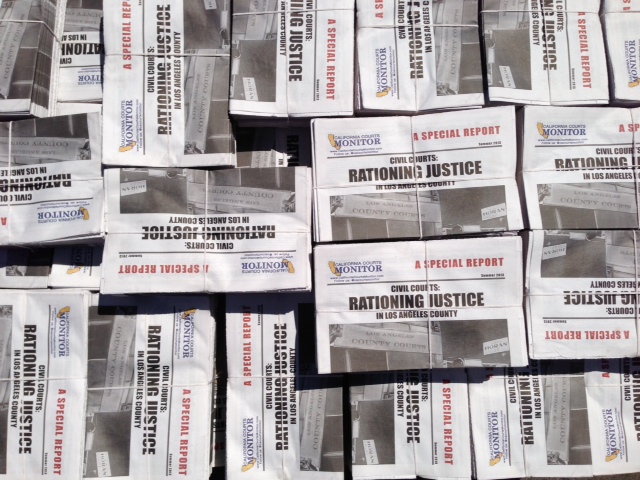
CCM issues first ‘special print report’

Who says new media can’t be old school? Today, the California Courts Monitor is releasing a special report, on old-fashioned newsprint no less, in the Los Angeles area. Distributed free all over the city, the idea is to increase awareness of the ongoing civil courts crisis while also explaining a new focus online.
 
When we launched the CCM, we hoped to highlight great writing on the judicial process and celebrate the extended legal community. But what we’ve found is a true crisis in the civil court system, so we have decided to become the only site — that we know of, anyway — to consolidate coverage of those issues.
 
We’ll be posting parts of the special report here in the coming days and if you live in the Los Angeles area keep an eye out for the depression-era photo illustration. You’ll know it when you see it. — The Editors.
 
(Note: you can download a pdf of the complete Special Report here.)

Barstow Gets Limited Court From ‘Couch-Cushion’ Money

They were somewhere around Barstow, on the edge of the desert, when the budget cuts took hold. But it turns out that the Barstow courthouse will not be entirely closed, as has been thought, but will instead offer limited services, according to the Press-Enterprise newspaper’s Crime Blotter blog
 
The report reports that “… San Bernardino County Superior Court has become the poster-child for budget cuts to the state court system, with May 6 shutdowns scheduled for its courthouses in Barstow, Needles and Big Bear. But now a small bit of good news. The California Judicial Council has come up with some couch-cushion money from a statewide reserve, and the $1.2 million in emergency funds will allow one courtroom in the Barstow Courthouse to stay in business three days a week, through June 2014.
 

The newspaper says the court in Barstow will hear traffic, landlord-tenant, small claims and domestic violence cases while civil, family law and criminal cases will still have to be heard elsewhere. Those who get their cases heard in Barstow will be spared a 32-highway-mile, one-way drive to the nearest fulltime court in Victorville. Needles residents whose cases fit the limited Barstow docket will get 30 miles cut from their 174-mile, one-way drive to Victorville.

See the story here.  

‘Charging A Cover’ To Access Courts? $10 Charge For Records Prompts Lots of Pushback

It’s no surprise that a proposal to charge $10 per file for routine court document access is getting lots of pushback, and our favorite comment comes from a quote in the Courthouse News Service from a Sacramento judge named Steve White, who compares it to a cover charge:  “It would put almost anyone who covers court news out of business,” said White. “Whether that’s the intention or not, that would be the result. Through that lens you can appreciate that it’s not much different than asking a cover charge to watch the trials we preside over.”
 
Judge White was reacting to costs for covering the courts. The CNS gives this example: “… a newspaper reporter reviewing the day’s newly filed cases for news would be hit with a ten-dollar fee for every case reviewed, a sum that would add up to roughly $400 a day in San Jose’s superior court and $700 a day in San Francisco.” The story also notes that nobody really bothered to project income from the fee and other issues.
 

Read it here.

Federal Courts Now Face Own Shutdowns

It’s not just California’s state courts facing widespread closings these days. Federal courts, blaming the across-the-board “sequestration” budget cuts enacted because Congress and the president couldn’t reach a financial deal, are being blamed for employee furloughs and once-a-month courtroom closings, according to The Courthouse News. The CN said that “San Francisco, San Jose and Eureka Federal Courts will shut down on the first Friday of each month, and Oakland Federal will close the first Monday of the month.”
 
The report quotes Judge Julia Gibbons, who chaired the federal Judicial Conference Budget Committee, explaining that sequestration put the judiciary in “uncharted territory,” facing a “budget crisis that is unprecedented, one that is not likely to end in the near term.” Another quote that sounds a lot like the state judges talking about their financial problems: “We believe we have done all we can to minimize the impact of sequestration, but a cut of this magnitude, particularly so late in the fiscal year, will affect every aspect of court operations.”
 
Read more on the issue here.


Editorial Boards Continue To Lament Court Cutbacks

The new rationing system for California justice is gaining attention of the mainstream press, and over the past few weeks some of the state’s newspaper editorial boards have taken stands. It’s interesting that the opinions tend to be numbers-filled, a sign that the writers know their readership is not yet up to speed on the issue. You can add a very fine Sacramento Bee editorial, bylined by “the editorial board,” to the list.
 
Notes the Bee: “According to the [state] chief justice, since January 2010, 22 courthouses have closed across the state, 114 courtrooms have been shuttered, 30 courts have reduced their hours of operations, and more than 2,600 court employees have either been laid off or left and were not replaced… Scores of specialty courts for veterans, the homeless, people with mental illnesses and drug addicts have gone by the wayside.
 
“The result – access to justice, particularly the civil side of justice, has been dangerously curtailed.
In Sacramento County, for example, more than a quarter of the courthouse workforce, 230 people, has been laid off or left and not been replaced since 2008. Family law litigants seeking to divorce or settle child custody and support matters can wait up to seven hours to file documents… Help that used to be available to assist those litigants, 70 percent of whom come without lawyers, has been slashed to the bone. Help with forms, telephone responses and via email is nearly gone. Twenty-five counter service windows have been closed and the hours reduced for those that are left. Even janitorial services have been cut to the most basic level.”
 
Read the lament here.