
Non-Representation Of Immigration Children Sheds Light On System

As reported by the LA Times: Karla Salazar, right, and Ellen Leonard on Tuesday joined nearly 100 demonstrators at the naval base in Port Hueneme, where hundreds of immigrant children are being housed. (Robert Gauthier / Los Angeles Times)

As reported by the LA Times: Karla Salazar, right, and Ellen Leonard on Tuesday joined nearly 100 demonstrators at the naval base in Port Hueneme, where hundreds of immigrant children are being housed. (Robert Gauthier / Los Angeles Times)

In a country where citizens are only vaguely aware that immigration is mostly controlled by civil, not criminal, courts, the ongoing “unaccompanied children” crisis is serving to shed some light on how the civil courts work – or, more exactly, how they sometimes don’t work. Now a coalition of immigration groups has filed a federal lawsuit against the United States over non-representation of these children, The Los Angeles Times is reporting.

 
The Times reports that “… the immigrant advocacy groups that filed suit are targeting ongoing actions in which immigration officials have initiated proceedings to deport thousands of minors, both recent arrivals as well as those who have lived for years in the United States but without permission. Many of the children never hire attorneys, appearing in court by themselves. Because immigration cases are civil, not criminal proceedings, defendants are not guaranteed the right to legal counsel.”
 
The immigration groups make the same basic argument that other juvenile advocates make, “… attorneys argue that children are not equipped to represent themselves in serious cases that can determine their future, lacking the intellectual and emotional capacity of adults as well as knowledge of legal remedies that may be available to them.”

Meanwhile, federal authorities say that some of the 243 immigration judges in 59 courts nationwide will be reassigned to hear the cases, either at the border or by video with some new judges appointed temporarily. Clearly, the issue is not going away – read some of the Times’ excellent coverage here.

U.S. sued for not providing attorneys to children in immigration court
Child-Immigration Crisis Also A Civil Court Crisis

With President Obama asking Congress for a quick $2 billion to address the growing crisis on the U.S.-Mexican border, it is worth noting that the system failure is not just about immigration policy or border enforcement – it’s really a failure of civil courts capacity. Many Americans learning about the crisis are surprised to discover that immigration issues are “civil” and not “criminal,” and that the core of the problem is that tens of thousands of children are due a day in court – and that day will not come for years and years.
 
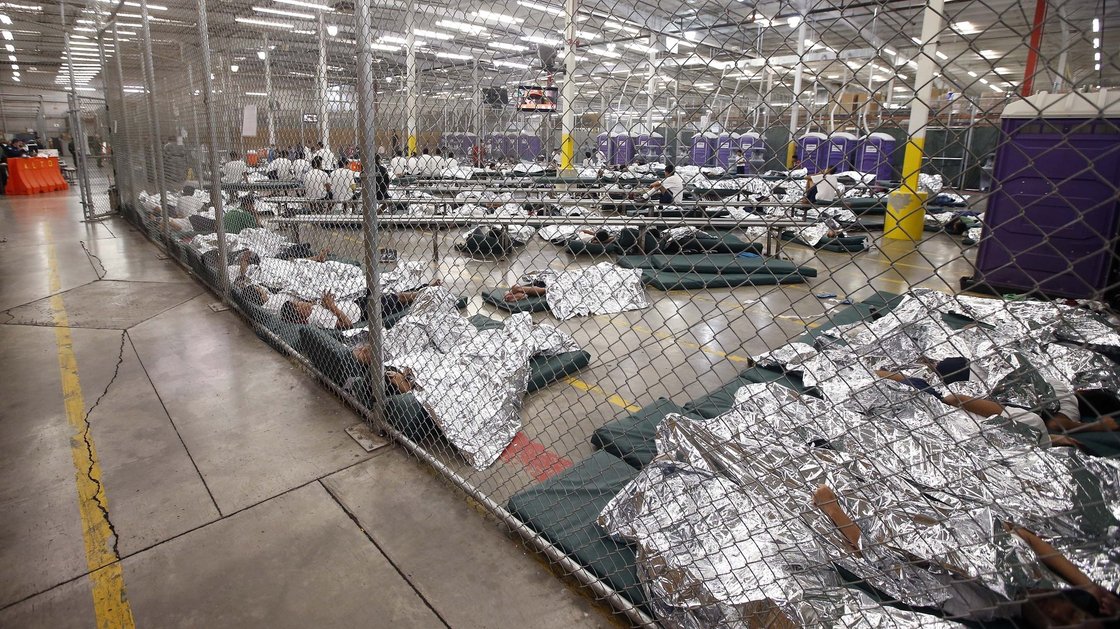
As reported by NPR: Detainees sleep and watch television in a holding cell where hundreds of mostly Central American immigrant children are being processed at a U.S. Customs facility in Nogales, Texas.

As reported by NPR: Detainees sleep and watch television in a holding cell where hundreds of mostly Central American immigrant children are being processed at a U.S. Customs facility in Nogales, Texas.


Background: National Public Radio and others are drawing attention to the fact that, over the past nine months, “… more than 50,000 children and teenagers have crossed that border illegally on their own, most from Central America. By law, the administration can’t deport those young people until they have an immigration hearing — a process that can take years.” The immigration law is different for people from Mexico, who can be returned much faster.
 
Says NPR: “… law requires the U.S. to hold an immigration hearing before deporting a child from Honduras, Guatemala, El Salvador or any other country that doesn’t border the U.S., says Marc Rosenblum of the Migration Policy Institute. The law aims to protect vulnerable young people from being inadvertently sent home into forced labor or the sex trade.”
 
“While they wait for that immigration hearing, the law also requires that they be held in the least restrictive custody setting,” Rosenblum tells NPR. “What that means in practice is that most of these kids are getting placed with family members in the U.S. while they wait for an immigration hearing.”
Because the immigration courts are overloaded, the average wait is nearly two years, Rosenblum adds in the NPR coverage.
 
That means what we’re seeing is really a high-profile example of what happens when civil courts can’t meet demands. There is very likely a similar situation in many of our family courts and other systems, and those will eventually bring their own “crisis” headlines.


Here’s the NPR report: Obama To Ask Congress For $2B To Ease Immigration Crisis

Sen. Feinstein Discovers Need For Child Representation

The Los Angeles family court may be limping along and we may be closing facilities and programs important to juvenile justice, but Sen. Dianne Feinstein has at least discovered the need for representation for children being detained under civil (as opposed to criminal) immigration issues. In an opinion piece for the Los Angeles Times, she says of the detained, “… it is also imperative that child advocates be provided for these children, both while they are in federal custody and upon release to family members or sponsors. The children need representation as their court cases advance, and no child should be forced to navigate the U.S. legal system alone.”
 
She also wrote that she applauds “… the Justice Department’s Executive Office for Immigration Review for expanding juvenile dockets across the country to handle immigration cases for these children. Otherwise, these cases could easily get lost in current backlogs, forcing these children to live in the shadows indefinitely.” All this, of course, only after a flood of negative publicity over current practices of holding thousands of children without much of a plan on how to process them or return them home. 
 
Read the senator’s position here:

After Fed Court Ruling, ICE Detainee Requests Go Unheeded

 
Reflecting on the fact that many immigration detentions are civil, rather than criminal, actions, more than 100 jurisdictions across the United States have stopped enforcing “holds” issued by the Immigration and Customs Enforcement agency, or ICE. The policy changes follow a federal court ruling in Oregon declaring such practices unconstitutional.
 
More than a dozen of the counties changing the practice are in California, including Los Angeles and San Diego, where authorities have stopped complying with the ICE detainer requests, reports the Orange County Register. The newspaper quotes Julia Harumi Mass, a senior staff attorney with the ACLU of Northern California: “Detaining people based on suspected civil immigration violations without probable cause not only wastes scarce local public safety resources and contradicts our sense of fairness – it undeniably violates the Fourth Amendment to the U.S. Constitution.” 
 
Read the Register report by Roxana Kopetman here.