Report Offers Details About Immigration Court Backlog

As reported in Al Jazeera America: "The nation’s immigration courts got a bit of relief at the beginning of June, when the Department of Justice hired 18 new immigration judges. But the courts are still facing a major backlog.Illustration by Sam Ward for Al Jazeera America"

As reported in Al Jazeera America: “The nation’s immigration courts got a bit of relief at the beginning of June, when the Department of Justice hired 18 new immigration judges. But the courts are still facing a major backlog.Illustration by Sam Ward for Al Jazeera America”

A new report by Bruce Wallace, writing for Al Jazeera America, details just how stalled the nation’s busiest immigration courts are, and how backlogged they remain. Writing from New York, he reports that “… depending on how you count it, this courthouse — actually a collection of 31 small courtrooms scattered across two floors of a tall federal office building in downtown Manhattan — is either the busiest or second busiest of the 58 immigration courts in the country. The one in Los Angeles got more new cases last year — a little over 18,000, compared with around 17,700 for Manhattan. But Manhattan has more cases pending: 60,538 compared with 51,878 in L.A. Or, on average, about 2,240 cases per New York judge. Judges in comparable courts have about 700 cases a year, according to the American Bar Association.
 
The story goes on: “Death-penalty cases in a traffic-court setting” is how Dana Leigh Marks likes to put it. She’s an immigration judge in San Francisco and president of the National Association of Immigration Judges (and, as such, one of two immigration judges in the country who are permitted to speak to the media). “The volume alone is like traffic court, and yet the stakes for someone who asserts a claim of asylum, if I am wrong — or even if I’m right but, because the law doesn’t allow me to grant relief, I have to deny them — they could be going back and facing death.”
 
Immigration courts, despite their name, are not actually part of the federal courts system. They are part of the Justice Department and the judges do not have much power over their colleagues who represent the government. They are civil courts, so there is no right to have counsel provided. Nationally, some 450,000 cases are pending with wait times reaching half a decade.
 

SF Immigration-Murder Case May Be ‘Willie Horton’ of 2015

The broad-daylight killing of a woman by an undocumented immigrant is becoming a political football, and the San Francisco Chronicle gets it right by saying: “… from the presidential stage to California’s local political contests, it may be accused killer Juan Francisco Lopez-Sanchez, a Mexican citizen with a string of deportations and drug-related felonies in the U.S., who becomes this year’s Willie Horton and shapes the debate over illegal immigration.”
 
The report quotes a political science professor saying that the victim’s death “… has catapulted itself onto the national stage, because it allows those who are running in the heartland to talk about all the liberal icons and all the stereotypes associated with San Francisco… in some way, this is becoming a Willie Horton moment for the country.”
 
But the story also reminds us that  more than 320 jurisdictions have sanctuary policies similar to San Francisco. Supporters say such policies help, among other things, foster trust with people living in the community without documentation. Meanwhile, the USA Today coverage tells us that more than 10,000 people have been released that federal authorities wanted held.
 
The USA Today and Chronicle stories are below.


It Had To Happen: Immigrant Avoids ICE Hold, Now A Murder Suspect

It made headlines last year as jurisdictions, acting on a federal court decision out of Oregon, decided they would not honor “hold” requests by U.S. Immigration and Customs Enforcement, known as ICE. Now a San Francisco murder suspect was freed despite such a hold request just before committing the alleged killing. But an attorney for the San Francisco Sheriff’s Department says “…nothing in his background showed anything like that.”
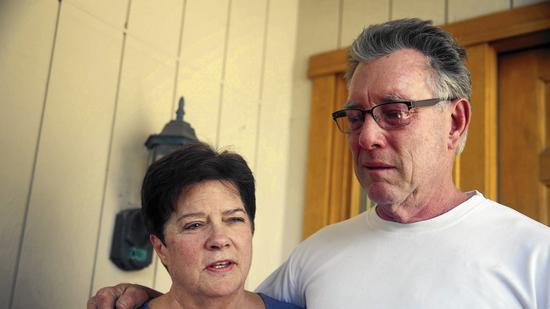
As reported in the LA Times: Liz Sullivan and Jim Steinle, parents of Kathryn Steinle, who was fatally shot Wednesday in San Francisco. A suspect with seven felony convictions who had been deported five times has been arrested in connection with the shooting. (Lea Suzuki / San Francisco Chronicle)

As reported in the LA Times: Liz Sullivan and Jim Steinle, parents of Kathryn Steinle, who was fatally shot Wednesday in San Francisco. A suspect with seven felony convictions who had been deported five times has been arrested in connection with the shooting. (Lea Suzuki / San Francisco Chronicle)

 
Says an ICE spokesperson: “An individual with a lengthy criminal history, who is now the suspect in a tragic murder case, was released onto the street rather than being turned over to ICE for deportation… we’re not asking local cops to do our job. All we’re asking is that they notify us when a serious foreign national criminal offender is being released to the street so we can arrange to take custody.”
 
San Francisco County Sheriff Ross Mirkarimi said ICE misses the point. “ICE was informed about San Francisco’s position on detainers,” he said, “but did not seek a court order for Sanchez’s transfer as required under the law.”
 
The Courts Monitor follows immigration issues because the cases are civil, not criminal. Read more from the L.A. Times here:
 

NYT Gives Family Detention Camps Front-Page Status

 
The Sunday New York Times gave migrant detention centers front-page treatment, profiling a big camp in Texas. Activists will no doubt note that the report does not mention the context of the detentions – nearly a half-million migrants await their day in immigration court – or that the “courts” are actually administration employees and part of the justice department.
 
But there is some notice taken on the lack of lawyers and that some people languish because they can’t post the “bond” to get out. The one amount noted in the report was $1,500.
 
Says the NYT: “While the number of people crossing the border illegally has dropped sharply this year, families continue to come. Since Oct. 1, more than 17,000 parents and children have been caught along the Southwest border, according to official figures. At the Dilley camp, more than half the detainees are children. Their average age is 9… The centers were designed to hold the women while they fight their cases in the immigration courts, part of the administration’s expansion of family detention to more than 3,000 beds nationwide, from only 95 a year ago.”
 
We will see if the NYT treatment is enough to make the issue a priority. Read the story here.

Another NBC I-Team Bombshell On Immigration Court Crisis

 
There must have been a memo. Another NBC station is breaking news on the immigration court crisis, with the New York affiliate reporting on a huge loophole for entering the U.S. The station’s in-depth coverage includes that “… according to court sources… [the source] is at least the 14th Amandeep Singh from the Punjab state of India to seek immigration help in Queens Family Court — a place better known for custody and child support cases. Singh tells a judge he was abused by his parents, starved and beaten with sticks. Although this may be completely true, judges say they have no investigative recourse. After one hour in court, Singh, who is undocumented and was smuggled across the border, was well on his way to getting a green card, permanent legal status and the right to work in the U.S.”
 
Read the story here.

TV News Report Includes Director’s Rare Comments Demanding Change

 
A California NBC TV affiliate has scored a rare interview with the director of the nation’s immigration system, and he’s not holding back in blaming lawmakers for what amounts to a broken system. Bay Area NBC says that “… in his first ever TV interview on camera, the Director of the Executive Office for Immigration Review (EOIR) tells NBC Bay Area that only a complete overhaul by Congress will truly fix the issues plaguing the current system.”
 
“There’s no question that the system, the immigration court system, is under incredible stress right now,” Director Juan Osuna told the NBC Bay Area Investigative Unit, which conducted the interview in Washington, D.C. The multi-part report says that “… according to EOIR’s latest figures, US Immigration Courts received 306,045 cases in 2014 alone. Many of those cases were never heard, adding to a backlog which now totals 445,607 according to Syracuse University’s Transactional Records Access Clearinghouse, or TRAC.”
 
The comments are rare, both because of what NBC called “tradition” and also because the immigration system, including the judicial branch, are not “courts” at all but really are a function of the Department of Justice. 
 
See the milestone story here.

Immigration Court Backlog Nearly A Half-Million Cases

The latest update from the Transactional Records Access Clearinghouse at Syracuse University, the group most-cited for keeping track of the immigration courts backlog, sets the number of pending cases at a new all-time high of 445,000, with “routine” hearings being delayed for up to four years.
 
The Los Angels Times is among those taking notice, saying that the rising caseload “… is a nearly 30% increase since Oct. 1, 2013, the start of the last fiscal year” and “… immigration courts have been overwhelmed since the influx last fiscal year of more than 68,500 unaccompanied children and about as many family units crossing the southern border, most from Central America.”
 
They also noted a changing trend, because “… most backlogged cases involved Mexican immigrants, their backlog has increased only about 4% since the start of last fiscal year, while the backlog has skyrocketed for Central Americans — up 63% for Guatemalans, 92% for Salvadorans and 143% for Hondurans.”
 
Federal data indicates that California, Texas, and New York led the nation with the largest immigration backlogs, followed by Florida and New Jersey.
 
The nation’s “immigration courts” are actually a division of the Justice Department, not really federal courts at all. The system report that it has 233 judges in 58 courts nationwide and officials say 17 more are expected to start by month’s end with 68 more are in the process of being hired. But Judge Dana Leigh Marks, who’s been on the bench for 28 years and is president of the National Assn. of Immigration Judges, told the L.A. Times that some 100 immigration judges were expected to retire this year.

How Clinton’s Immigration Policy Would Differ From Obama’s

 
Presumptive Democratic presidential nominee Hillary Clinton made headlines by calling for a path to full and equal citizenship for undocumented immigrants, but offered few details on how her programs as president would go beyond what President Obama has done by executive order. Immigration cases are civil actions and some 400,000 cases are backed up in the special “immigration courts” which are actually operated by the U.S. Justice Department, not the usual courts system.
 
The left-leaning website ThinkProgress has a solid analysis of how Clinton’s ideas differ from Obama’s, noting that the candidate “… called for granting ‘full and equal citizenship’ to undocumented immigrants; extending an existing executive action that provides deportation protections to so-called DREAMers, or undocumented immigrants, giving legal representation to immigrants in immigration court; and reforming immigration enforcement and detention practices ‘so they’re more humane, more targeted, and more effective.'”
 
See more of the analysis here.

Driving Issue: 131K Licenses Issued To Undocumented In California

Citing state officials, Reuters is reporting that California issued “about 131,000 driver’s licenses to undocumented immigrants in January and February, the first two months since the state began granting the permits to people who are in the country illegally.”
 
The news services added that “the most populous U.S. state joined nine others and the District of Columbia in granting licenses to drivers regardless of immigration status, a controversial move that marked a significant shift in policy toward immigrants in California.” The lack of a driver’s license has long been a problem in the Golden State, prompting some cities to issue their own forms of ID.
 
Between 2 million and 3 million unauthorized immigrants are believed to live in California, making them the nation’s largest such population. Immigration courts, meanwhile, face a backup of some 400,000 cases. Such cases are civil, not criminal, proceedings. To read more about the driving issue, click here.

Lawyer, Location Not Law, Determine Fate Of Asylum-Seeking Children

Access to a lawyer and location of their case is very much more likely to determine the fate of “Border Kids” than laws or other factors, according to a POLITICO analysis that found a “very uneven brand of justice” in U.S. immigration courts. The analysis of government data “… shows that fully 88 percent of the removal orders issued since July have gone to children without an attorney. What’s more, a juvenile assigned to judges in Texas, North Carolina and Georgia in the past 16 months was at least three times more likely to receive such an order than a child in California, Florida or New York.”
 
The resulting POLITICO story implies that the Obama Administration’s “hall pass” on the crisis, which exploded into headlines last summer but diminished in the wake of reform promises, is nearly expired. The D.C.-based publication wrote that “… the same humanitarian crisis that gripped the White House and Congress last year is now a less visible one of American justice. And it still poses a major test for the Obama administration, which promised compassion and fairness in the treatment of the child migrants but also contributed to the current problem by expediting deportation proceedings.”
 
The report is likely a game-changer because it documents the range of outcomes under a “single federal system,” which illustrates it’s anything but a single system. The research compares and contrasts outcome, documenting that “… the number of removal and voluntary departure orders in Texas and North Carolina was 3.5 times the level in California and Florida.