New York Corruption Trial Said To Be Moving Quickly

 
The New York Times is reporting that the high-profile criminal trial of former state assembly speaker Sheldon Silver is running quickly, with prosecutors indicating they might wrap up their case by mid-week. This week the highlight of the case was revelation of a letter that prosecutors contend prove Silver received “kickbacks” via a law firm.
 
The Times reported that “… in the scheme described in court on Thursday, prosecutors say Mr. Silver received about $700,000 in kickbacks through the Goldberg law firm — secret compensation for Mr. Silver’s having referred it tax business from Glenwood and a second developer. In return, as the government said in the trial’s opening statement, Mr. Silver took official action that benefited the developers, like meeting with Glenwood’s lobbyists and signing off on critical real estate legislation that Glenwood supported.”
 
(Editor’s Note: This site usually focuses on civil, not criminal, cases. We do update the Silver trial because it focuses on referral payments for civil cases.)

 

Obama Immigration Case Has Implications For Presidential Race

The Christian Science Monitor, or a we call it around here “the other Monitor,” has an excellent analysis of how President Obama’s executive action case might influence the 2016 presidential race. You may have noted that a federal court sided with a lower court that the president over-reached in his actions that effected about 5 million of the estimated 11 million undocumented folks in the United States.
 
The CSM notes the timing: “If the Supreme Court opts to hear the case, it would likely issue a decision next June – just as the 2016 presidential race is heading into the home stretch. And the implications for the Latino vote could be big, not only for the top of the ticket but also in key Senate races in states with large Latino populations, such as Nevada, Florida, Colorado, and Illinois.”
 

President’s Immigration Action Headed To Supreme Court?

As reported by Reuters on 11/10/15: "U.S. President Barack Obama delivers remarks at an Organizing for Action event in Washington November 9, 2015. REUTERS/Yuri Gripas"

As reported by Reuters on 11/10/15: “U.S. President Barack Obama delivers remarks at an Organizing for Action event in Washington November 9, 2015. REUTERS/Yuri Gripas”

In a move that seems likely to bring the U.S. Supreme Court into the legal fray over President Obama’s executive actions on immigration, the 5th U.S. Circuit Court of Appeals in New Orleans decided 2-1 to uphold a May injunction against the measure. Reuters notes that the decision “… deals a blow to Obama’s plan, opposed by Republicans and challenged by 26 states. The states, all led by Republican governors, said the federal government exceeded its authority in demanding whole categories of immigrants be protected.”
 
Millions of immigrants are effected by the court decision but “discretion” in law enforcement is expected pending further legal appeals, most likely to the Supreme Court.
 

Read more at Reuters.

Court Tells Feds To Lay Off Medical Pot Providers

A federal judge seems to have settled an issue between federal law enforcement and local marijuana operations in states with laws allowing legal pot. At issue was an amendment to a federal spending bill saying that law enforcement cannot use federal funds to go after marijuana operations or users in states that have laws governing such things. As Washington Post blogger Christopher Ingraham explains, “… when the legislation was passed, advocates and lawmakers on both sides of the issue agreed that the bill basically prevented the DEA from going after medical marijuana dispensaries, provided that such dispensaries were acting in compliance with state law. The DEA, however, didn’t see it that way. In a leaked memo, the Justice Department contended that the amendment only prevents actions against actual states — not against the individuals or businesses that actually carry out marijuana laws”
 
The judge did not find that argument at all amusing. Read the results here: Federal court tells the DEA to stop harassing medical marijuana providers

By the Playbook: Power, Greed & Corruption.

As reported in the NYT 4/4/15, "Sheldon Silver, the former New York State Assembly speaker, arrived at federal court in Manhattan on Tuesday. Credit Seth Wenig/Associated Press."

As reported in the NYT 4/4/15, “Sheldon Silver, the former New York State Assembly speaker, arrived at federal court in Manhattan on Tuesday. Credit Seth Wenig/Associated Press.”

When it comes to the Sheldon Silver corruption trial this week, you certainly can follow Politico’s “Playbook” advice and “pick your news.” The NY Post and Times are illustrating that the GOP/Dem. divide certainly makes for contrasting coverage. But Politico’s NY Playbook is doing a solid job linking to various sources, reporting this week in a curtain-raiser story that Silver “… has maintained his innocence and said he was looking forward to this day. On this mild autumn Tuesday, the man who led the State Assembly for over two decades wrapped himself in the system of Albany. What prosecutors cast as misdeeds — collecting referral fees from a real estate law firm employed by major developers and a firm that represented asbestos patients treated by a medical researcher that Silver gave state funding — were presented as the inevitable conflicts of a part-time Legislature where lawmakers have side jobs.”
 
(This is, of course, a criminal trial. The civil court implications come from allegations that Speaker Silver is charged with a kickback scheme involving referrals for mesothelioma victims, gaining millions of dollars in referral fees while funneling state funding to the clinic making the referrals.)
 
And we’re off…

Safety Advocates, Lawyers Target Big Box Retailers In ‘Yellow CSST’ Natural Gas Pipe Issue

As originally published in the Huffington Post.

Straight out of Lubbock, Texas comes the latest escalation of a nationwide battle over how millions of American homes receive natural gas fuel. As Buddy Holly’s hometown considers becoming the first U.S. community to adopt a new standard for a certain type of gas piping, an advocacy foundation is asking big-box retailers Lowe’s, Home Depot and Menards to stop selling the “yellow CSST” pipe/tubing under question.

At issue, explains the non-profit Brennen Teel Foundation For Gas Line Safety, is a type of flexible gas tubing called “yellow CSST,” which stands for “corrugated stainless steel tubing.” Developed in Japan and prized for flexibility that allows it to survive earthquakes and empower easier installation than black iron pipe, CSST has been used for decades.

However, in recent years, yellow CSST has alarmed many because of house fires caused by lightning that hits homes, or near homes, and may damage the tubing. Lubbock officials determined the death of 31-year-old Brennen Teel was caused by yellow CSST failing after a 2012 lightning strike.

I’ve noted before how Brennen’s tragic death sparked an advocacy campaign and illustrates that America’s litigation system can push reform. Expansive testing of the gas tubing has been done by victim’s attorneys, and a strongly worded letter “warning” builders over the summer came not from regulators but from lawyers. (To anticipate comments: We all realize that the attorneys have a self-interest in the research, but I truly believe this effort goes beyond “client relations.”)

Lavera Vincent, executive director of the Teel Foundation, confirmed that the organization sent letters on Sept. 17th, to Home Depot, Lowe’s, and Menards asking that they stop selling yellow CSST.

One worry: CSST should be installed by gas contractors who have been certified by the manufacturers. Given the history of yellow CSST, and the challenges with lightning and the reliance of contractors properly installing the product to specific manufacturer guidelines, it’s actually hard for me to understand why these big box stores would make it available where unsuspecting non-contractor homeowners could buy it and install it themselves.

In fact, sources tell us that the largest CSST manufacturers refuse to sell via the “big box” stores because of concerns that the general public does not have enough information or the expertise about how to properly install CSST.

“As you may know,” the Teel letter to retailers states, “yellow CSST has been linked to deaths and property damage due to lightning-related fire that can lead to perforation of this particular yellow gas piping.”

The letter also notes that “… certain new products on the market are adhering to a higher standard for lightning resistance (referred to as LC1027) which has proven effective. We request that you carry a safer product so consumers are unable to purchase yellow CSST off-the-shelf.”

Even when there are proper controls in place, the installation requires bonding and separating the yellow product in a specific way to make it safer when lightning hits a house. Despite extensive education efforts, there is little confidence that these steps are always achieved. That is probably why two of the leading manufacturers do not even sell “yellow” CSST anymore.

Apparently, only one leading manufacturer, Ward Manufacturing, Inc., owned by Hitachi is still selling yellow CSST in the U.S., joining two smaller players Proflex and Homeflex. This begs the question, why are Ward and others refusing to raise their standard for this gas piping when advancements in technology have created an alternative for American homeowners?

Moving to the higher standard is also a stated goal of Lubbock’s senior building officials.

Steve O’Neil, Lubbock’s chief building official for more than a quarter-century, has explained to National Courts Monitor producers that a special “fuel gas committee” was formed after Brennen’s death to look into their situation and is recommending that Lubbock become the first U.S. community to adopt the highest standard for CSST pipe going forward.

O’Neil explains that CSST comes in three broad categories known first by color: “yellow,” which was the go-to product for decades, and two kinds of more recent “black” CSST. He says a few brands control about 80-plus percent of the CSST market, so for shorthand he notes that the FlashShield brand is one type meeting a LC1027 standard while another common brand, CounterStrike, represents what’s known as the LC1024 standard. By comparison, the LC1027 tests the product to 8 times higher electrical arcing energy than the LC1024.

Generally, CSST made to the LC1027 standard incorporates a protective metal shield. And we should be clear that many building professionals contend that yellow CSST is safe, if properly installed, which includes proper bonding and physical separation from other metallic systems – thus the Teel request for “strong warning” if retailers continue to sell the pipe. The Teel Foundation disputes that, contending that the do-not-sell request “… is specific to yellow CSST product as it has been the subject of failure even with the proper bonding and ground of the product, including Brennen’s case.”

O’Neil, the Lubbock official, agrees that increased safety comes with evolving to the higher standards. He says “… there’s just a huge difference” in safety performance and the cost difference is really pennies per foot.

The fire-code community is taking notice of the Lubbock situation, in part because there are hundreds of CSST-related lawsuits around the country. In the U.S., where fire codes are a patchwork of local rules influenced by national standards, these cases are how change happens.

So far, Vincent and the Teel Foundation seem pleased with the quick acknowledgement of their request to the retailers. We’ll keep an eye out for their formal response.

As the debate ensues, anyone still selling yellow CSST should know that the “LC1027 standard” has some highly motivated activist-lawyers mobilizing to support new standards. So, in that world, all eyes on Lubbock.

NYT Going Deep On Arbitration Issue

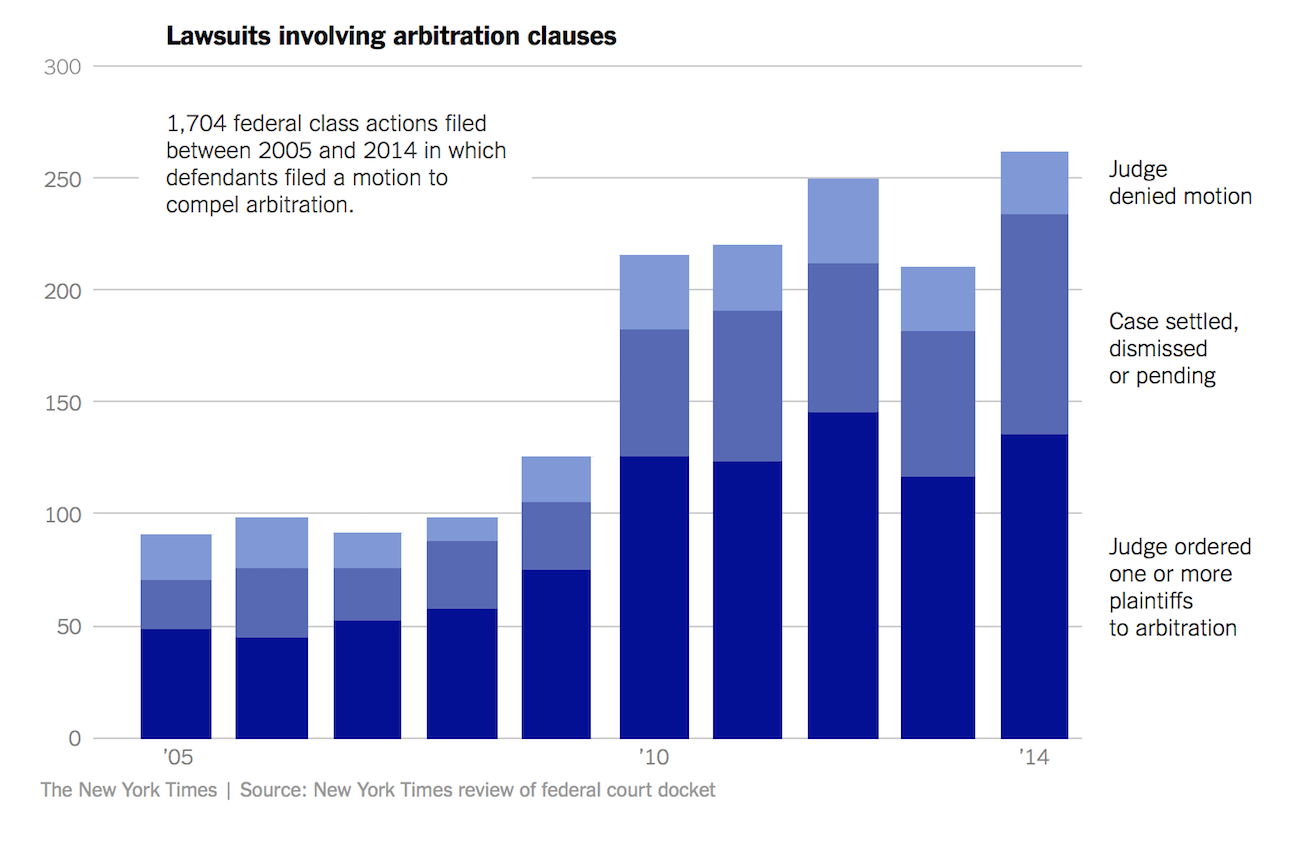
Image from NYT report, 11/1/15.

Image from NYT report, 11/1/15.

The New York Times continues its milestone series on arbitration this week and continues to set the stage for serious reform, especially in California where the practice is widespread across many industries. In particular, the series focuses on how arbitration clauses can remove disputes from courts into private practices.

The paper says that those practices “…often bears little resemblance to court… Over the last 10 years, thousands of businesses across the country — from big corporations to storefront shops — have used arbitration to create an alternate system of justice. There, rules tend to favor businesses, and judges and juries have been replaced by arbitrators who commonly consider the companies their clients, The Times found.”

This is the kind of series that nearly always brings a call to action, so stay tuned. Check in on the series here.

Rep. Sanchez: Factory Shows Immigration Success

As originally posted in the Huffington Post.

With immigration emerging as a pivotal issue in the 2016 presidential election, everyone from Donald Trump to Pope Francis is embracing rhetoric that advances their positions. So, whether you are a brick in the wall or a wrecking ball, it seems you either want to build a wall to keep people out, or build policies to let people in.

[Read more…]

Lawyers Fight Bail Inequality By Filing More, Smaller Cases

The New York Times has a story about how some lawyers are battling bail inequality by filing small-town lawsuits, forcing policy changes one town at a time – but hoping to spark wider reforms. The NYT reports that there are many cases that illustrate the problem among the nation’s 15,000 trial courts, and both local and national groups are “… waging a guerrilla campaign to reverse what they consider unconstitutional but widespread practices that penalize the poor. These include jail time for failure to pay fines, cash and property seizure in the absence of criminal charges, and the failure to provide competent lawyers.”
 
This story is part of a significant trend toward reforming that limbo where “civil” cases, like fines and potential property seizure, evolve into situations where people can be arrested. Read it here: Court by Court, Lawyers Fight Policies That Fall Heavily on the Poor.

Bi-Partisan Trials Allege Corruption In New York

You have to admit that two looming corruption trials in New York are at least bi-partsan. One will be of a Democrat, New York’s former Assembly Speaker, Sheldon Silver (slated to begin Nov. 2) and another is of a Republican, former Senate Majority Leader Dean Skelos, two weeks later. The Wall Street Journal says the trials are “.. set to expose the inner workings of a cast of characters that stretches from the state capital to Nassau County to Columbia University, and to some of the country’s biggest law and real-estate firms.”
 
Both men, charged in totally separate cases, are both charged with schemes in which they are alleged to have used their public offices for personal gain. Silver is accused of raking in millions in civil court-related referrals as part of a process where he pushed state money to a clinic in return for that clinic sending asbestos-cancer victims to his law firm, which has not been accused of doing anything wrong.
 
It will be the stuff of New York litigation legend. See the WSJ coverage here: Albany Braces for Corruption Trials