Trial Court Operations Still Facing Budget Shortfalls

The state’s trial courts are facing diminished revenues from case filing fees and penalties, and that’s bringing some pressure on budget decisions. The Courthouse News explains that “… though Gov. Jerry Brown’s budget gives California trial courts $90.6 million in new funding, the state Judicial Council slashed $22.7 million across the board to address a shortfall in a critical fund for trial court operations…”
 
The CN also notes that “… the courts have seen diminished revenues from case filing fees and penalties for two fiscal years now. Brown’s budget included $66 million to compensate for that deficit, but the Trial Court Trust Fund is still short $22.7 million…  the council voted unanimously to take the money out of the $90.6 million before it is allocated to the courts.
 

Report Offers Details About Immigration Court Backlog

As reported in Al Jazeera America: "The nation’s immigration courts got a bit of relief at the beginning of June, when the Department of Justice hired 18 new immigration judges. But the courts are still facing a major backlog.Illustration by Sam Ward for Al Jazeera America"

As reported in Al Jazeera America: “The nation’s immigration courts got a bit of relief at the beginning of June, when the Department of Justice hired 18 new immigration judges. But the courts are still facing a major backlog.Illustration by Sam Ward for Al Jazeera America”

A new report by Bruce Wallace, writing for Al Jazeera America, details just how stalled the nation’s busiest immigration courts are, and how backlogged they remain. Writing from New York, he reports that “… depending on how you count it, this courthouse — actually a collection of 31 small courtrooms scattered across two floors of a tall federal office building in downtown Manhattan — is either the busiest or second busiest of the 58 immigration courts in the country. The one in Los Angeles got more new cases last year — a little over 18,000, compared with around 17,700 for Manhattan. But Manhattan has more cases pending: 60,538 compared with 51,878 in L.A. Or, on average, about 2,240 cases per New York judge. Judges in comparable courts have about 700 cases a year, according to the American Bar Association.
 
The story goes on: “Death-penalty cases in a traffic-court setting” is how Dana Leigh Marks likes to put it. She’s an immigration judge in San Francisco and president of the National Association of Immigration Judges (and, as such, one of two immigration judges in the country who are permitted to speak to the media). “The volume alone is like traffic court, and yet the stakes for someone who asserts a claim of asylum, if I am wrong — or even if I’m right but, because the law doesn’t allow me to grant relief, I have to deny them — they could be going back and facing death.”
 
Immigration courts, despite their name, are not actually part of the federal courts system. They are part of the Justice Department and the judges do not have much power over their colleagues who represent the government. They are civil courts, so there is no right to have counsel provided. Nationally, some 450,000 cases are pending with wait times reaching half a decade.
 

SF Immigration-Murder Case May Be ‘Willie Horton’ of 2015

The broad-daylight killing of a woman by an undocumented immigrant is becoming a political football, and the San Francisco Chronicle gets it right by saying: “… from the presidential stage to California’s local political contests, it may be accused killer Juan Francisco Lopez-Sanchez, a Mexican citizen with a string of deportations and drug-related felonies in the U.S., who becomes this year’s Willie Horton and shapes the debate over illegal immigration.”
 
The report quotes a political science professor saying that the victim’s death “… has catapulted itself onto the national stage, because it allows those who are running in the heartland to talk about all the liberal icons and all the stereotypes associated with San Francisco… in some way, this is becoming a Willie Horton moment for the country.”
 
But the story also reminds us that  more than 320 jurisdictions have sanctuary policies similar to San Francisco. Supporters say such policies help, among other things, foster trust with people living in the community without documentation. Meanwhile, the USA Today coverage tells us that more than 10,000 people have been released that federal authorities wanted held.
 
The USA Today and Chronicle stories are below.


NY Passes ‘Aspirational’ Civil Gideon Measure

 
Here’s another civil Gideon milestone: New York’s senate and assembly have passed a non-binding “policy” of providing legal assistance to “persons in need of the essentials of life,” becoming the first state to take such action to provide civil representation. San Francisco and other cities have some level of civil Gideon programming.
 
The resolution was suggested in a 2014 report to Chief Judge Jonathan Lippman by the Task Force to Expand Access to Civil Legal Services, to make the case for increasing available state funding for civil legal services over the past five state budgets.
 
Read more here.

Housing Rules Yet Another Huge SCOTUS 5-4 Decision


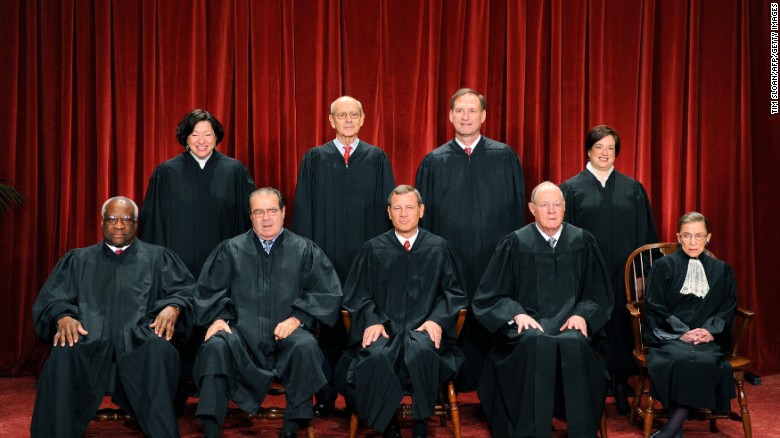
Photo from CNN report: Justices of the U.S. Supreme Court

Photo from CNN report: Justices of the U.S. Supreme Court

Obamacare and same-sex marriage naturally dominated attention over recent U.S. Supreme Court decisions, but a huge housing issue also got a 5-4 ruling that leans toward the court’s liberal side. The court, in effect, re-affirmed a federal law passed in 1968 to combat housing discrimination by, as CNN explained, “… holding that the law allows not only claims for intentional discrimination but also, claims that cover practices that have a discriminatory effect, even if they were not motivated by an intent to discriminate.”
 
Justice Anthony Kennedy wrote the 5-4 opinion for a closely divided Court concerning the scope of the Fair Housing Act. He noted that “… much progress remains to be made in our nation’s continuing struggle against racial isolation.” His opinion was joined by Justices Ruth Bader Ginsburg, Elena Kagan, Sonia Sotomayor and Stephen Breyer.
 
Opponents including the state of Texas argued that the law punished outcomes without any intent of harming anyone, and actually injects more, not less, race into housing development decisions.
 
Read the CNN coverage here.

Monitor Publisher Offers High Praise For Plaintiff’s Research

 
In her most recent Huffington Post column, the Courts Monitor publisher offers strong praise for a byproduct of litigation – research. She also notes that lightening is more likely to hit your home than you might think and that the natural gas pipes used in building need a strong reform movement. Check it out here.


How A $100 Traffic Ticket Grows To A $495 Fine

 
The Bakersfield.com news website has a good breakdown of why California is in the middle of a traffic-fine rebellion, with millions of drivers going unlicensed and emergency measures halting the practice of forcing payment before allowing people to contest their tickets. 
 
Milt Younger. Photo: The Bakersfield Californian.

Milt Younger. Photo: The Bakersfield Californian.

Milt Younger, a longtime attorney writing for the op-ed page, explained that a hypothetical “$100 ‘average” ticket will actually cost a driver $490. Even tickets in the $25 range, for example for failing to notify the DMV within 10 days of moving, will swell to $196. Do the math on how much a $300, or $1,000 ticket will cost.”
 
The additions have to do with the array of fees added over the years. For example, the “state penalty assessment” is $10 for every $10 of base fine and something called a “conviction assessment” is another $35 while the “county fund” is $7 for each $10 of base fine.
 
It’s a good argument for starting over. Check it out here.

Traffic ‘Debtors Prison’ Decried As California Courts Struggle

 
The San Diego Reader has a story up about how Orange County created a revenue-generating operation from traffic fines, collecting “bail” up front to both discourage challenges and assure court attendance. As with other areas around the nation, the traffic court has become a focal point in both terms of race and ability to pay.
 
Ken Harrison’s story in the Reader quotes Bill Niles, president of the California Traffic School Association, saying, “This was unconstitutional. Nobody should have to pay the fine before seeing a judge. People have had their cars taken away and their driver’s licenses suspended just because they couldn’t pay the fines. It was like debtors’ prison.”
 
Read the story here.

NYT Gives Family Detention Camps Front-Page Status

 
The Sunday New York Times gave migrant detention centers front-page treatment, profiling a big camp in Texas. Activists will no doubt note that the report does not mention the context of the detentions – nearly a half-million migrants await their day in immigration court – or that the “courts” are actually administration employees and part of the justice department.
 
But there is some notice taken on the lack of lawyers and that some people languish because they can’t post the “bond” to get out. The one amount noted in the report was $1,500.
 
Says the NYT: “While the number of people crossing the border illegally has dropped sharply this year, families continue to come. Since Oct. 1, more than 17,000 parents and children have been caught along the Southwest border, according to official figures. At the Dilley camp, more than half the detainees are children. Their average age is 9… The centers were designed to hold the women while they fight their cases in the immigration courts, part of the administration’s expansion of family detention to more than 3,000 beds nationwide, from only 95 a year ago.”
 
We will see if the NYT treatment is enough to make the issue a priority. Read the story here.

Civil Court Watchers Turn Attention To Kansas

 
In what is shaping up as an historic political showdown, civil court watchers are looking toward Kansas. That’s where Gov. Sam Brownback is, in effect, saying that if a state court strikes down a 2014 law that removed some judicial powers, he will halt court funding.
 
The New York Times explains that “… the 2014 law took the authority to appoint chief judges for the district courts away from the Supreme Court and gave it to the district courts themselves. It also deprived the state’s highest court of the right to set district court budgets. Critics said the law was an attempt by Mr. Brownback, a Republican, to stack the district courts with judges who may be more favorable to his policies.”
 
It’s getting uglier by the day. Check out the NYT coverage here.