Report: Even Litigation Settlement Department Getting Cut

 
If one result of the ongoing Superior Courts cutbacks will be forcing more out-of-court settlements, that will apparently have to occur without much help from the department that helps folks settle, according to a public radio station report. The KPCC newsroom reports that “… the Alternate Dispute Resolution department stopped accepting referrals [this month]. Those cases involve arbitration, mediation and other matters in which litigants in civil, family or probate disputes opt to settle outside of a courtroom.”
 
Reporter Erika Aguilar also notes that the ADR department began closing offices at courthouses this month and will continue with closures next month [May]—aiming to wrap up all ADR cases by May 10. On the job front, with more than 500 jobs expected to be cut, Aguilar cites court spokesperson Mary Hearn saying in an email last month that she wasn’t sure how many employees would be laid off. “Layoffs will be done according to seniority,” Hearn wrote. “There is no direct correlation between the locations shutting down and the staff employed in those locations being laid off.” 
 
The excellent KPCC report also has info on which courthouses will be closing. Read it here


Court funding: Politics large and small

Article from CCM’s Special Report – CIVIL COURTS: RATIONING JUSTICE IN LOS ANGELES COUNTY

A few weeks after a big downtown rally against Los Angeles Superior Court reorganization, a middle-aged man who had attended the protest walked into a Starbucks next to the Stanley Mosk Courthouse and ordered an elaborate latte concoction.

“It would be different,” he mused as they prepared the drink, “if the judges were elected.” 

He must have been thinking of federal court, because the Superior Court judges held up as out-of-touch 1 percenters at the protest ARE elected, albeit in the most unheralded races anyone might imagine. That near-total lack of political interest is a key reason that this “special report” is a long-form accounting of what amounts to simple political Darwinism.

[Read more…]

Looking for ‘literature,’ finding civic revolt

By Sara Warner, from CCM Special Report

It wasn’t supposed to be like this. After some time Back East, I was moving back to California where I’ve lived nearly all of the past 17 years. When talk turned to a courts website last year, our pretensions were mostly literary: we wanted www.californiacourtsmonitor.com to celebrate “the writing” about justice, like that you get from Associated Press Special Correspondent Linda Deutsch or maybe even less known voices like James Preston Allen, the publisher of San Pedro’s “Random LengthNews.” (Not, by the way, that Mr. Allen is likely to care all that much.)

It seemed logical enough. It was a good project that meshed nicely with my day job as development director for a non-profit legal foundation. Also, I grew up with the Law (capital “L” in our house). My grandfather was a famous lawyer and my grand uncle was a Federal Court judge. Who knew we would find a civil courts system in what amounts to full-on revolt?


IMG_0725


[Read more…]

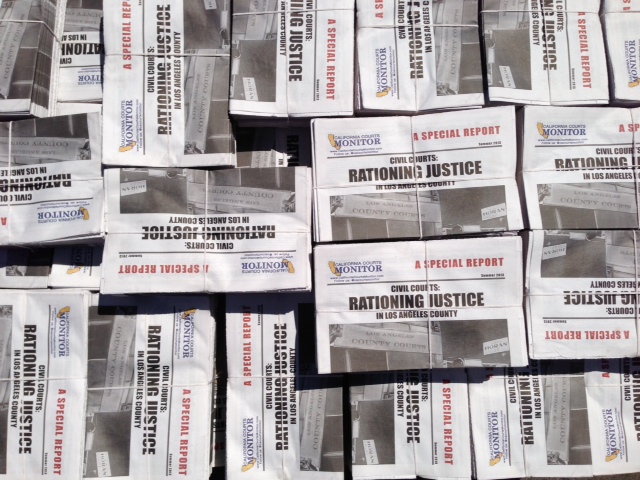
CCM issues first ‘special print report’

Who says new media can’t be old school? Today, the California Courts Monitor is releasing a special report, on old-fashioned newsprint no less, in the Los Angeles area. Distributed free all over the city, the idea is to increase awareness of the ongoing civil courts crisis while also explaining a new focus online.
 
When we launched the CCM, we hoped to highlight great writing on the judicial process and celebrate the extended legal community. But what we’ve found is a true crisis in the civil court system, so we have decided to become the only site — that we know of, anyway — to consolidate coverage of those issues.
 
We’ll be posting parts of the special report here in the coming days and if you live in the Los Angeles area keep an eye out for the depression-era photo illustration. You’ll know it when you see it. — The Editors.
 
(Note: you can download a pdf of the complete Special Report here.)

Report: Services Slashed, Trials Delayed As Court Cutbacks Take Hold

You might think that domestic violence restraining orders would be same-day service by California courts. But you wold be wrong in at least 11 counties, according to the Trial Court Presiding Judges Committee. Plus, some 38 counties have reduced self-help services for litigants without lawyers, according to a report in The Los Angeles Times.
 
A story by Maura Dolan (maura.dolan@latimes.com) adds to the details stacking up as the state courts cutbacks take hold. She writes that “California courts, reeling from years of state budget cuts, are delaying hearings and trials, allowing records to sit unprocessed for months and slashing services at public windows, a judge’s committee has reported.”

The story offers some highlights: In San Francisco, paying a traffic ticket can now take up to four hours, and filing a lawsuit can consume nearly three hours, the report said. In Sacramento, window services have been slashed by more than 75%, prompting fights in lines, according to the committee. Getting a trial in a traffic matter in San Diego requires at least a five-month wait, the survey found, and court closures have forced some San Bernardino residents to drive up to 175 miles one way to attend to a legal matter. Record-filing has slowed across many counties and created backlogs, the report said.

Read the latest here.

More Pushback On Judicial Spending, Lawmaker Sends Strong Warning

When the chairperson of a legislative committee appears at a subcommittee hearing, they want to get people’s attention, according to Recorder blogger Cheryl Miller, and that is what happened recently when Assemblyman Bob Blumenfield, D-Van Nuys, visited a courts budget meeting.
 
Miller, writing in the Recorder’s LegalPad blog, notes that Blumenfield told the group that “… while the state grappled with a budget crisis, court administrators sometimes have acted fiscally irresponsible even though fiscal responsibility was the mantra of the day… We’ve seen a failed computer system with years of cost overruns and nearly $500 million wasted. In the process, the courts took millions from trial courts — sacrificing access to justice — to keep the failed computer project running. This year, the court system will likely enter an agreement and spend $100 million more than we should to build a new courthouse in Long Beach.”
 
That is another indication of dueling narratives as the state rations access to justice. Miller writes that, “… reading between the lines, the Assembly’s top budget official seemed to be saying that if the Legislature does restore any judicial funding, it’s going to come with some serious strings attached.” It also indicates that not everyone is buying the idea that the courts are with “the people” on spending issues.
 

Read the Miller blog here.

Groups Ask State Court To Block Courthouse Cutbacks

Groups opposing Los Angeles Superior Courts cutbacks have taken their cases to a state court after a federal court judge decided not to rule on their argument. They say the state-level effort is to cover their bases while planning an appeal on the federal dismissal. The Inland Valley Daily Bulletin is quoting Maria Palomares, a lawyer working with the Neighborhood Legal Services organization, as explaining that, said the appeals court should act urgently to reverse the policy, implemented March 18, that would cram the county’s 70,000 annual eviction cases into just five courtrooms.
 
Last year, tenants could go to 21 courthouses to try to avoid being kicked out of their homes, the paper reported. Palomares argued this creates a hardship for tenants who would have to commute for hours to courthouses as far as 60 miles away to fight eviction. The groups noted that when Federal Judge Terry Hatter quickly dismissed the earlier lawsuit he did not rule on the merits but indicated a different court should hear the case.
 
The Daily Bulletin story was written by Christina Villacorte: christina.villacorte@dailynews.com @LADNvillacorte on Twitter. Read the story here

Heat Is On Judges With Court Cutbacks

Asking some hard questions about how California courts are managed, a column by James Preston Allen puts the focus on the judicial branch. The publisher of the website Random Length News (www.randomlengthnews.com) actually compares the justice system to church. It’s an important voice because it pushes back on the judicial branch argument that the finger should be pointed at the state budget.
 
In a recent column, he wrote: “When you think about it, courts and churches do have some striking similarities. Both have these large symbolic edifices with intimidating rooms of pomp and ritual where attendees sit in rows. One is refrained from approaching the altar, judicial or otherwise, unless invited and the officiators for either God or law all wear ceremonial robes. I could go on, but I think you get the point. Just as we have segregated God from pedestrian access, so too have we separated justice from the common civic experience. It’s about to get worse in our California justice system.”

Allen follows that with a list of financial issues, noting that the current crisis ” is just more of the unintended consequences of balancing the state budget while screwing the taxpayers.” That column has been picked up by City Watch L.A. and you can read the details here.

L.A. Court Cuts Becoming Model For Others

If anyone was wondering if the reorganization and centralization of the Los Angeles County court system would become a model for others, they can stop. It, of course, is. The most recent public example came from the Bakersfield Californian as the paper, in an editorial, said that counties will “… have to get creative, and some already have. Los Angeles County Superior Court, faced with an even bigger shortfall, will create specialized hubs where certain cases will be processed, such as personal injury, limited civil, small claims, collections and unlawful detainer [eviction] matters. All general civil personal injury and some civil actions, for example, must be filed at a single specified courthouses… Kern County officials will have to look at those and similar models to keep the already-overburdened court system moving…”
 
Kern County is like many others in facing big local cuts, and faces a $3.7 million deficit. The Californian outlines other options and notes “… some suggested more than a year ago by then-Los Angeles County Presiding Judge Lee Smalley Edmon, include simplifying criminal and civil procedures — something that’s long overdue regardless of budgetary necessity.”

You can see the editorial and get more details here.

‘Charging A Cover’ To Access Courts? $10 Charge For Records Prompts Lots of Pushback

It’s no surprise that a proposal to charge $10 per file for routine court document access is getting lots of pushback, and our favorite comment comes from a quote in the Courthouse News Service from a Sacramento judge named Steve White, who compares it to a cover charge:  “It would put almost anyone who covers court news out of business,” said White. “Whether that’s the intention or not, that would be the result. Through that lens you can appreciate that it’s not much different than asking a cover charge to watch the trials we preside over.”
 
Judge White was reacting to costs for covering the courts. The CNS gives this example: “… a newspaper reporter reviewing the day’s newly filed cases for news would be hit with a ten-dollar fee for every case reviewed, a sum that would add up to roughly $400 a day in San Jose’s superior court and $700 a day in San Francisco.” The story also notes that nobody really bothered to project income from the fee and other issues.
 

Read it here.