In Sacramento, New Presiding Judge Confronts ‘Crisis’

“Keeping the doors open will be a major accomplishment in and of itself,” says the incoming presiding judge of the Sacramento Superior Court in an interview with The Courthouse News. The story notes that Judge Robert Hight says he feels he hopes “… to make good use of hard times [because] a good crisis is always the best place to make major changes.”
“The biggest challenge is clearly budget and how can we provide a level of services the public deserves given the budget that we have,” Hight told the CN. Along with the judges comments, the story offers a good brief history of several court trends, dating back to the days of the initial round of case management system backlogs, circa 2007.

 

Hollywood Screenwriters Couldn’t Make This Story Up

For sheer TV-drama level civil court action, albeit on the installment plan, you can’t get much better than the multi-billion-dollar slugfest between San Ramon-based Chevron Corp. and a New York attorney that’s playing out in New York this month. At issue is a roughly $19 billion 2011 judgement from an Ecuadoran court against Chevron. 
 
But this case is not an appeal or even a lawsuit against Chevron. It is actually against the attorney who spearheaded the Ecuadoran case, Steven Donziger. The oil company is suing Donziger under federal laws for, in effect, conspiring to commit fraud. The trial has been going on for weeks, featuring an array of admittedly corrupt judges, outtakes from the documentary film “Crude” that are an entire case in themselves and some of the nation’s most powerful law firms.
 
Donziger has denied all the allegations. The trial is a real peak into how big-time civil cases are financed and how at least one case had enough intrigue for Hollywood. And, yes, there are already films in the works. Get started with a story about how a respected Philly firm rolled into the scandal here.

CCM Publisher Takes Views To Huffington Post

Sara Cocoran Warner, Founding Publisher of the California Courts Monitor

 
Sara Cocoran Warner, founding publisher of the California Courts Monitor website, has taken her views on rationing justice to The Huffington Post. In two recent posts, she outlines dramatic predictions after a Los Angeles Superior Court “reorganization” closed a juvenile court facility and what it means that some cases get priority over others.

You can see her HuffPo posts here:


Marin County Superior Court on ‘losing end’ of budget reallocations

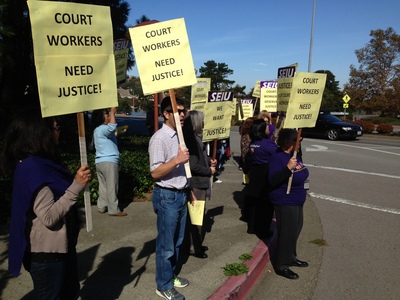
Photo: Marin Independent Journal as part of their report on 10/25/13 "Marin court employees, raiseless for five years, rally for better pay"

Photo: Marin Independent Journal as part of their report on 10/25/13 “Marin court employees, raiseless for five years, rally for better pay”

According to a report by Gary Klien of Marin Independent Journal, dozens of court employees in Marin County, with representatives of their union, SEIU Local 1021, rallied outside the courthouse late last month to campaign for better pay, benefits and dispute resolution after five years of frozen wages.  

Doesn’t look like this will be resolved anytime soon…Court employees are seeking a $4,000 one-time payment, while Marin Superior Court, which is run by the state judicial branch, is offering a one-time payment of $725.  

According to the Marin IJ report, Kim Turner, the court’s chief executive officer, said the entire state judiciary has been underfunded for years and that things are not going to get easier in the next five years. Turner explained that it is because the state has adopted a new allocation process that will send more of the limited resources to courts that are perceived, based on caseload calculations, to be needier.

“Marin is on the losing end of that bargain,” Turner said.  Read or view the story here.


Petty Politics Detailed In Former Chief Justice’s Book

Wow – think you understand just how petty California budget politics can get? You might decide you’ve been underestimating after reading a new book from former California Chief Justice Ronald M. George, who retired from the bench in 2011. The way-way-former Los Angeles Municipal Court Judge has released an 800-page volume as part of the court’s oral history project and outlines just how personal funding could become.
 
The Los Angeles Times online is reporting that “… George said legislators sometimes opposed court bills out of anger at rulings. The state high court’s 2008 decision in favor of gay marriage caused Republicans to abandon a court bill they had previously supported.” He said other lawmakers would not support funding because of divorce bitterness and “… one legislator refused to support a revenue bond for court construction because his wife had received what he viewed as an excessive fine for making a rolling stop, George recalled. The bond depended on raising fines.”
 
For anyone hoping to understand the court-legislative relationship, the book is shaping up as a must-read. For the thousands of laid-off court workers, it is bound to illustrate just how little the judicial system, and indeed individual lives, can mean to some lawmakers. Read the L.A. Times piece by Maura Dolan here.

‘Routine’ Bay Area Court Decision Taking Years

It sounds fairly routine: A town’s government thinks development is good for an area, but environmentalists and others say officials have not demanded the kinds of research required by law. So you go to court for a decision, and how long should that take? In the Bay Area community of Newark, they are at three years – and counting.
 
At issue is a non-developed area of the town that many want to preserve. After taking several years to develop a master plan, and gain official support, developers found themselves facing a lawsuit in 2010. A Contra Costa Times newspaper report says that “… the lawsuit has meandered through the courts for the past three years, with all parties still waiting for a definitive ruling. A case management conference involving a judge and the attorneys for both sides is scheduled Nov. 12.”

It has become a case study in the courts’ role in such controversies, with added significance in an area of civil court delays and cutbacks. Read more about it here.

San Bernardino Lawyers Brace For Their ‘Reorganization’

 
The next wave of Superior Court reorganization is slated for San Bernardino early next year, and lawyers there are not happy about the changes, according to The Sun newspaper. The Sun reported that “… attorneys spoke to executive staff at the San Bernardino County Superior Court last week about alternatives to a planned reorganization that will have some people traveling farther distances for court cases.
 
Lawyers involved in the meeting told the newspaper that suggestions of cost savings and other ideas were not going to change the situation. The presiding judge of the county’s Superior Court announced in October that significant changes would occur next year during the 2014 realignment, which would include moving countywide civil cases to the new San Bernardino Justice Center.
 
See the story here.  

Courts Contracts Info Denied To Reform Judge

It’s an ongoing issue, but you might think that getting copies of all the current vendor contracts for California courts would be (A) a cure for insomnia and (B) fairly easy. Think again. Because “A” may be true but “B” is proving difficult for a judge who has been critical of the judicial administration, reports the Voice of San Diego website, a non-profit investigative news outlet.
 
The VofSD reports that “… Kevin McCormick, a trial judge in Sacramento who also heads a court reform-advocacy group called the Alliance of California Judges, asked state court administrators earlier this year for copies of all their current contracts with vendors. He was surprised to hear that they did not have that information available… the courts had literally interpreted [open records act] Rule 10.500 to mean that they did not have to “create” a public record of their contracts — even at the request of a judge.”
 
Judge McCormick went on to question how such a large system runs without a list of vendor contracts. You can read more about the issue here.

Judges Might Hear Cases Of Political Donors

A California Supreme Court ethics committee is seeking comments on a draft opinion that would allow state judges to hear cases of lawyers whose firms have donated to the judge’s campaigns, just so long as no single attorney trying that specific case has given more than $1,500. Judges would have to disclose the contribution, but could still hear the case.
 
The Metropolitan News is reporting details that “… the issue involves the interpretation of Code of Civil Procedure Sec. 170.1(a)(9)(a), which mandates judicial disqualification when a “lawyer in the proceeding” has donated more than $1,500 to the judge’s campaign. The draft opinion would clarify that the statute does not apply to contributions by a firm, and does not provide for aggregation of smaller contributions by individual lawyer.”
 
The deadline for comment on either opinion is Nov. 15,  and comments may be submitted at the site, or by email, or by regular mail. The draft opinions and invitation to comment are posted on the committee’s website here. The full MetNews story is here.

Chief Justice Notices ‘Two-Tiered’ Court System

 
Chief Justice Tani Cantil-Sakauye (Photo: California Courts)

Chief Justice Tani Cantil-Sakauye (Photo: California Courts)


Anyone seeking evidence that California has created a two-tier system that denies justice to lower income residents can just ask the state’s chief justice. Echoing a host of earlier comments, Tani Cantil-Sakauye told KQED News that “The truth is, those who can will use other, private alternatives… but those of us who need to go to the court, who don’t have those resources, find ourselves frankly getting a second system of justice.” 
 
The report also included that “… the Chief said severe state budget cuts had created a ‘two-tier system of justice’ in California, where shuttered courthouses and shorter courtroom hours are ‘basically denying justice across the state.'” The comment continue a consistent message from state court managers that the system is broken and that the losers include lower and moderate income people who need the courts.
 
See video and read more about this particular interview, which includes that the chief justice self-identified as a Republican, here.