New Group Will Advocate For California Courts

A new non-profit group has been formed to, in the words of its press release this week, “… increase awareness about the relationship between adequate state funding for the administration of justice – at the state and local level – and the ability to deliver equal access to justice for all.” The “Foundation for Democracy and Justice” also says it plans to educate the public about the branches of government, with particular attention paid to the role of the judiciary.
 
In the wake of cutting a billion dollars from the courts budget over the last half-decade, many critics of the cuts have noted that some lawmakers have forgotten that the judiciary is an equal branch of government. The new organization’s initial membership seems to include fairly prominent civic leaders and some high-profile attorneys. 
 
California Chief Justice Tani Cantil-Sakauye and state Attorney General Kamala Harris were announced as “honorary directors” of the group. The Sacramento Bee has a story here.

Gov. Brown Vetoes Limits On Court Outsourcing

By MARIA DINZEO 

In a move bound to be greeted as anti-labor by union leadership, California Gov. Jerry Brown has vetoed a bill that would have required any courthouse-job outsourcing to include proof that it would actually save money. In effect, unions representing court workers had argued that outsourcing simply moved public money into private pockets.
 
In his veto announcement Monday, Gov. Brown said the bill went too far and required “… California’s courts to meet overly-detailed and — in some cases — nearly impossible requirements when entering into or renewing certain contracts.” He also said “flexibility” was part of his decision.
 
As Courthouse News noted in its coverage, the bill was primarily backed by the California Court Reporters Association and the Service Employees International Union and was considered a response to Placer County Superior Court’s firing of its entire court reporter staff and replacement with private contractors. Read the CN story here.

Monterey County Adapting To Justice Rationing

A story in the Monterey County Weekly documents adjustments to civil cases after years of budget cuts, including the hit to local small claims cases. Says the paper: “With the closure of the King City courthouse on Sept. 23, the calendars of the three other county courthouses – in Salinas, Marina and Monterey – are under pressure to pack in more cases.”
 
The report quotes Monterey County Superior Court Presiding Judge Marla Anderson: “With the same amount of filings, you have to do the same amount of work with fewer employees,” The Weekly says that labor expenses account for 79 percent of the county courts’ $21-million budget, which is now facing six years of cuts. Countywide, the Weekly adds, the court system has reduced its workforce by 52 positions since 2008.
 

Judge Says Court Closures May Bring Violence

Reduced access to civil courts will mean that people take the law into their own hands, including using violence in their disputes, according to a Los Angeles Superior Court judge. Phil Mautino, who is the supervising judge for the Los Padrinos Juvenile Court, told a Republican Lincoln Club group that personal injury cases are going to take five years to get to trial while for traffic court “there’s a line that circles around the building.”

“It means if you’re not going to court, you settle (the issue privately). It means violence. It’s like the old days of vengeance where if you kill my brother, I’ll kill your sister,” the judge told the Whittier Daily News in a recent report. “If you‘re willing to stand in line for a day or two, the officer may not show up [and] if you’re retired and plead not guilty, you have might have a good chance of getting off.” 

The Whittier courthouse was among the eight closed this year while two others have very limited services. All traffic court cases now are heard at the downtown Los Angeles and Beverly Hills court houses, small claims is limited to five courts (Downey for the Whittier area), and landlord-tenant evictions are divided between four courthouses.

See the story here.

Sacramento County Superior Court faces ‘tremendous challenges’ according to newly elected Presiding Judge

Photo credit: SUPERIOR COURT OF CALIFORNIA, COUNTY OF SACRAMENTO, Court Bulletin

Sacramento Superior Court Judge Robert C. Hight. (Photo credit: SUPERIOR COURT OF CALIFORNIA, COUNTY OF SACRAMENTO, COURT BULLETIN)

The Sacramento Bee reports that Sacramento Superior Court Judge Robert C. Hight has been elected as the court’s presiding judge, replacing the outgoing Presiding Judge Laurie M. Earl. The two-year term begins on January 1, 2014.

“Our court faces tremendous challenges,” Hight said in a news release. “Over the past four years, the Legislature reduced funding for the Judicial Branch by $1 billion. For our Sacramento County Superior Court, this was a reduction of almost 25 percent, resulting in the loss of almost 200 staff positions. Unless next year has projected budget changes, we face further cuts. Our judges and dedicated staff have been asked to do more with less. Our challenge is to continue providing the citizens of Sacramento with access to justice that is fair, timely and open to all.” 

Backlogs Prompt Some Courts To Re-hire

 
We’ve not heard about any plans in Los Angeles County, the nation’s largest trial court, but some other California court systems are re-hiring laid-off workers to deal with backlogs caused by, well, laying off workers. In particular, courts are looking at backlogs in family law cases.
 
It is interesting that the workers have reportedly been re-hired ONLY to deal with the backlog, leading to all kinds of labor questions. The Capital Public Radio station talked to some presiding judges (note that report is different from the print version). Read and listen to the story here.   

Jury Reform Ideas Beginning To Surface

With budget cutbacks and the threat of lawsuits over reduced justice access, you can guess that “court reform” is gathering steam as a key California issue. As part of that, you can add jury reform. Some ideas, and even proposed legislative action, are part of a Rosemary Jenkins column in CityWatch that very likely outlines the left-leaning view of future jury policy.

Jenkins, a regular CityWatch contributor who is also noted as chair of the Northeast Valley Green Coalition, spices up her policy observations with some first-person tales of jury duty. Her experience has the sound of truth, but it’s not exactly reassuring. She makes a case for non-citizens to serve on juries and calls for a new state law that will focus on “a jury of our peers” meaning more than just “those who did not evade jury duty.”

Of course, she is mostly dealing with criminal cases, not civil. But the jury pool overall is going to become an increasingly over-worked resource as more trials are held in centralized locations that require both seated and prospective jury members to travel longer distances. Read the ideas here.

Caseload Report Out, Will Have Budget Implications

 
The California “Courts Statistics Report,” or CSR, is out, and this year the formerly obscure document is bound for new attention as it will become part of a new budgeting formula. In a desperate attempt to put some level of oversight into how the courts spend money, especially on the civil courts, the new budget laws will take into consideration caseloads as reflected in the report. In general, the overall Superior Court case filings are actually down overall, but most of that comes from relatively simple cases like small claims. The more resource-intensive complex cases continue to increase.
 
Doubtless more analysis of the information will be produced soon. At first read, it seems there’s plenty of information for virtually any political argument, depending on perspective. For example, are the more simple cases, which are more often filed by individuals rather than lawyers relative to more complex cases, “down” because we’re all getting along? Or are more people just walking away because we’ve cut assistance in filing such cases, or because they couldn’t endure the filing line.

Long Beach Courts Move To New Public-Private Built Building

 
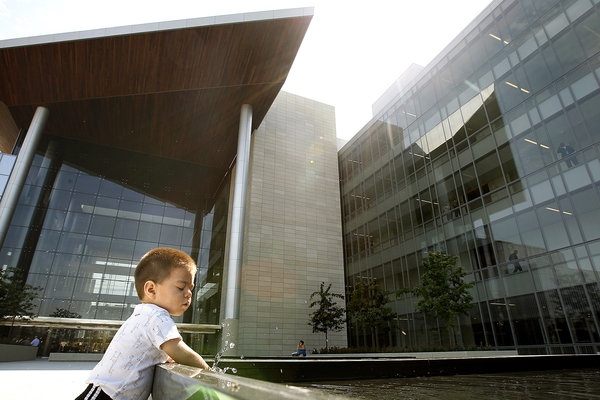
In an era of closing courthouses, a new one has opened. The $340 million, 531,000 square foot facility opened this week near the five-decades-old courthouse it’s replacing. It features two dozen courtrooms and will no doubt raise debate over how to pay for improved facilities. That is because it is the first to be built as a public-private partnership, complete with retail space.
The new Gov. George Deukmejian Courthouse in Long Beach. (Photo was published in the Los Angeles Times article "No rats and no lines, new Long Beach courthouse opens for business" on September 9, 2013.)

The new Gov. George Deukmejian Courthouse in Long Beach. (Photo was published in the Los Angeles Times article “No rats and no lines, new Long Beach courthouse opens for business” on September 9, 2013.)

 
The deal is that a group of real estate developers actually build the courthouse, paying for construction up front, and the state pays the cost plus interest over the next 35 years. Some critics of California’s court management say the public-private deal illustrates that the state is not all that great at building things. The Los Angeles Times covered the courthouse opening without noting the massive cost overruns of the state-only construction effort, but it did note that staffers were pushing leather chairs from one courthouse to the next.


Check out the story here

California Courts Monitor ‘Special Report’ Update now on stands and available for download

When we published our printed “Special Report” earlier this year, it detailed a court crisis facing a difficult season. Sometimes, it seemed that the looming cuts, coming after years of cuts, were mostly positioning for the ongoing state budget battle. In addition to our daily online offerings, we promised to update the print report at the end of summer, so that’s what we did, and it is now available in local coffee shops and newsstands or you can download it by clicking here

The takeaway? It was as bad, and sometimes worse, than expected. An environment of fear and insecurity only became more so. And we marveled at the number of people who would talk about courts issues, but only on condition we never name them. Think of that. These are people who are mostly afraid that judges — judges! — will actually punish them for voicing opposition. And some of those fearing retribution are lawyers.

In this Update, we have included more new material than we intended and highlighted one of our judicial profiles in a blatant attempt to show relevancy to a new audience — the national civil courts community. You can access the original here on our website or contact us directly at scw@californiacourtsmonitor.com for a printed copy.

And let us also say Thank You for the warm reception and backroom briefings prompted by our coverage. Our pledge is to get better and that our mistakes will be those of the head, not the heart.