Non-Representation Of Immigration Children Sheds Light On System

As reported by the LA Times: Karla Salazar, right, and Ellen Leonard on Tuesday joined nearly 100 demonstrators at the naval base in Port Hueneme, where hundreds of immigrant children are being housed. (Robert Gauthier / Los Angeles Times)

As reported by the LA Times: Karla Salazar, right, and Ellen Leonard on Tuesday joined nearly 100 demonstrators at the naval base in Port Hueneme, where hundreds of immigrant children are being housed. (Robert Gauthier / Los Angeles Times)

In a country where citizens are only vaguely aware that immigration is mostly controlled by civil, not criminal, courts, the ongoing “unaccompanied children” crisis is serving to shed some light on how the civil courts work – or, more exactly, how they sometimes don’t work. Now a coalition of immigration groups has filed a federal lawsuit against the United States over non-representation of these children, The Los Angeles Times is reporting.

 
The Times reports that “… the immigrant advocacy groups that filed suit are targeting ongoing actions in which immigration officials have initiated proceedings to deport thousands of minors, both recent arrivals as well as those who have lived for years in the United States but without permission. Many of the children never hire attorneys, appearing in court by themselves. Because immigration cases are civil, not criminal proceedings, defendants are not guaranteed the right to legal counsel.”
 
The immigration groups make the same basic argument that other juvenile advocates make, “… attorneys argue that children are not equipped to represent themselves in serious cases that can determine their future, lacking the intellectual and emotional capacity of adults as well as knowledge of legal remedies that may be available to them.”

Meanwhile, federal authorities say that some of the 243 immigration judges in 59 courts nationwide will be reassigned to hear the cases, either at the border or by video with some new judges appointed temporarily. Clearly, the issue is not going away – read some of the Times’ excellent coverage here.

U.S. sued for not providing attorneys to children in immigration court

AOC Name-Change Called ‘Superfluous’

As reported by MetNews.com, Steven Jahr is the California Administrator Director of the Courts.

As reported by MetNews.com, Steven Jahr is the California Administrator Director of the Courts.


Anyone thinking that the re-branding of the controversial “Administrative office of the Courts, or AOC” to the “Judicial Council staff” is window dressing might note comments by outgoing AOC Director Steven Jahr, who called the measure “superfluous,” according to the MetNews.
 
The MetNews notes that “… the name change announced Friday was seen by some judges as a harbinger of Jahr’s departure. At the Judicial Council meeting announcing the name change, Jahr was unusually freewheeling in his expression, saying, ‘Retiring the name AOC will produce a perceptual change, or perhaps a cultural change. Yet under the substantive law, it makes no change at all. The name is superfluous.'”

Jahr replaced William Vickrey, who, the MetNews story reminds us, “… left the AOC in September 2011 amid mounting controversy over the agency’s spending practices and a $500 million court technology project that judges and state legislators deemed a failure.”

Read the report here: Courts Director Jahr to Step Down After Two Years

Child-Immigration Crisis Also A Civil Court Crisis

With President Obama asking Congress for a quick $2 billion to address the growing crisis on the U.S.-Mexican border, it is worth noting that the system failure is not just about immigration policy or border enforcement – it’s really a failure of civil courts capacity. Many Americans learning about the crisis are surprised to discover that immigration issues are “civil” and not “criminal,” and that the core of the problem is that tens of thousands of children are due a day in court – and that day will not come for years and years.
 
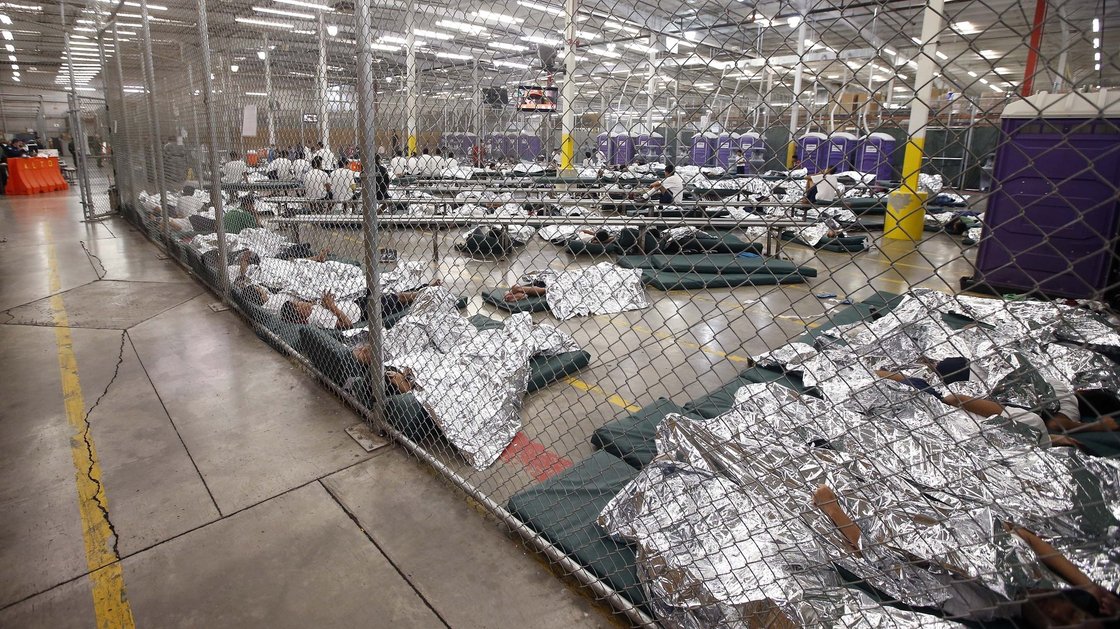
As reported by NPR: Detainees sleep and watch television in a holding cell where hundreds of mostly Central American immigrant children are being processed at a U.S. Customs facility in Nogales, Texas.

As reported by NPR: Detainees sleep and watch television in a holding cell where hundreds of mostly Central American immigrant children are being processed at a U.S. Customs facility in Nogales, Texas.


Background: National Public Radio and others are drawing attention to the fact that, over the past nine months, “… more than 50,000 children and teenagers have crossed that border illegally on their own, most from Central America. By law, the administration can’t deport those young people until they have an immigration hearing — a process that can take years.” The immigration law is different for people from Mexico, who can be returned much faster.
 
Says NPR: “… law requires the U.S. to hold an immigration hearing before deporting a child from Honduras, Guatemala, El Salvador or any other country that doesn’t border the U.S., says Marc Rosenblum of the Migration Policy Institute. The law aims to protect vulnerable young people from being inadvertently sent home into forced labor or the sex trade.”
 
“While they wait for that immigration hearing, the law also requires that they be held in the least restrictive custody setting,” Rosenblum tells NPR. “What that means in practice is that most of these kids are getting placed with family members in the U.S. while they wait for an immigration hearing.”
Because the immigration courts are overloaded, the average wait is nearly two years, Rosenblum adds in the NPR coverage.
 
That means what we’re seeing is really a high-profile example of what happens when civil courts can’t meet demands. There is very likely a similar situation in many of our family courts and other systems, and those will eventually bring their own “crisis” headlines.


Here’s the NPR report: Obama To Ask Congress For $2B To Ease Immigration Crisis

Writer Recaps Court Budget Situation

Much-watched Sacramento Bee Columnist Dan Walters, whose ideas go well beyond the state capitol, has published a good recap of the state’s court situation, outlining the recent history of shifting state funding from local to state authorities and concluding that: “Bottom line: The shift to state support was supposed to bring financial stability to the courts but instead has brought much higher instability.”
 
He offers this quick history: “When the Legislature and then-Gov. Pete Wilson agreed in 1997 that the state would assume the entire cost of financing California’s largest-in-the-nation court system, judges rejoiced… it was a big win for Ron George, whom Wilson had appointed as the state’s chief justice a year earlier, and he hailed ‘a stable and adequate source of funding’ as ‘one of the most important reforms in the California justice systems in the 20th century.'”
 
Walters also observes that “… the impact is being felt mostly on the civil side of courts because criminal cases command priority for restricted judicial resources. It can take literally years for a civil case to get a trial date.”
 
It’s a good read, but also a good story to file away for newcomers to how things got this way. Read it via the Mercury News here Dan Walters: California courts sought stability, found instability

More Bay Area Court Facilities Close

More court facilities are closing and more employees are losing their jobs in the Bay Area. The ongoing budget crisis is hitting Solano County Superior Court, where officials have announced cuts that include closing clerks offices, staff layoffs and shuttering the Family Law Clerk’s Office at the Solano Justice Building in Vallejo. The family law office closing means custody matters and other issues will be heard some 20 miles away in Fairfield, according to published reports.
 
The Reporter newspaper notes that, “… in announcing the cuts, local officials quoted California Supreme Court Chief Justice Tani G. Cantil-Sakauye in her comments on the state budget’s impact on courts. ‘This is the second year of partial reinvestment in the judicial branch after five years of severe budget cuts resulting in a reduction to access to justice. And while I appreciate the work of the Governor and the Legislature in increasing branch funding, especially given the context of this budget, the state revenues, the demands and the needs – unfortunately it is not enough to provide timely, meaningful justice to the public,’ she said. 
 
The Reporter also quoted local officials explaining that the current-year funding shortfall leaves the Solano courts with an $830,000 deficit going into the fiscal year. Read the story here: Solano County Courts announce closures, furloughs, layoffs for coming fiscal year

Brown Appoints Presiding Judges

The MetNews is reporting that Gov. Jerry Brown has named Court of Appeal Justice Frances Rothschild as presiding justice of this Los Angeles Div. One, and proposed three judges of other courts for appointment to other divisions. The website says that Los Angeles Superior Court Judge Brian M. Hoffstadt will be nominated as associate justice in Div. Two, former Los Angeles Superior Court Judge Presiding Judge Lee S. Edmon as presiding justice in Div. Three, and U.S. District Judge Audrey B. Collins as associate justice in Div. Four. 
 
Read the report, with background on the newly appointed and their confirmation process, here: Brown Names Rothschild and Edmon Presiding Justices of C.A.

Sen. Feinstein Discovers Need For Child Representation

The Los Angeles family court may be limping along and we may be closing facilities and programs important to juvenile justice, but Sen. Dianne Feinstein has at least discovered the need for representation for children being detained under civil (as opposed to criminal) immigration issues. In an opinion piece for the Los Angeles Times, she says of the detained, “… it is also imperative that child advocates be provided for these children, both while they are in federal custody and upon release to family members or sponsors. The children need representation as their court cases advance, and no child should be forced to navigate the U.S. legal system alone.”
 
She also wrote that she applauds “… the Justice Department’s Executive Office for Immigration Review for expanding juvenile dockets across the country to handle immigration cases for these children. Otherwise, these cases could easily get lost in current backlogs, forcing these children to live in the shadows indefinitely.” All this, of course, only after a flood of negative publicity over current practices of holding thousands of children without much of a plan on how to process them or return them home. 
 
Read the senator’s position here:

L.A. Presiding Judge: Expectations Not Met

There is more news from Presiding Judge David Wesley over the new state budget. The Metropolitan News-Enterprise is reporting on an email Judge Wesley sent to judicial officers saying that “… we are very disappointed in the level of support provided to the trial courts” and “… we had developed reasonable expectations, based upon our interactions with legislators, that we would find ourselves with additional resources with which to begin rebuilding our Court. Those expectations were not met.”
 
According to the MetNews, Judge Wesley explained that of the $223 million appropriated to the judicial branch, $40 million is for courthouse construction, $7 million for the appellate courts, $15 million for collaborative courts, $43 million for already-incurred expenses for employee benefit cost increases, and $30 million will go toward backfilling an expected revenue shortfall statewide.
 
“Only $86 million is scheduled for trial court operations—and even that amount will be reduced because the funding amounts for benefit cost increases and for revenue shortfalls are likely to be insufficient, with the gap made up out of funding for operation,” the judge explained.
 

‘One-Day’ Divorce Is National Trend

Of course it’s not really “one day,” but faster, do-it-yourself, lawyer-free divorces are becoming a national trend, according to the New York Times. A driving issue is cost, reports the NYT,  which reports that “… costs vary by location, but Randall M. Kessler, a family law specialist in Atlanta, said a typical divorce with no major disagreements over assets and custody issues might cost a few thousand dollars, while cases with significant disputes can easily cost $25,000 or more

 In California, says the report, roughly three-fourths of family law litigants lack lawyers, according to  Maureen F. Hallahan, supervising judge in the family law division at San Diego Superior Court. Typically, people file initial divorce paperwork on their own, but they don’t know what to do next, so their file languishes for months. Budget cuts in the state courts reduced available personnel and made the problem worse.

 Like most “one-day” programs, the term doesn’t mean a divorce is truly started and completed in a single day — residency and notification requirements have to be met first. You must, for example, already have filed a divorce petition and served your spouse with divorce papers to participate. But the program does allow you to wrap things up in a single day, or even a matter of hours, once you meet the initial criteria. “This is designed to help people get through the system,” said Judge Hallahan.

Read the story here: California Pioneers the Court-Aided One-Day Divorce

Presiding Judge: Justice Rationing To Continue

Los Angeles Superior Court Presiding Judge David Wesley say the just-passed California budget will not require additional staff reductions, but will also not replace previous cutbacks. The judge is being quoted in published reports saying that “… the California courts have suffered five years of reductions in state funding, and many courts have reduced their workforces by as much as one-quarter, with no lessening of their statutory and constitutional obligations. We are being forced to ration access to justice.
 
He added that “… people trying to do the right thing and pay a traffic ticket, find themselves stymied by long lines and antiquated technology… crime victims, and the law enforcement officers acting as witnesses in their cases, are burdened with long travel times because the local courthouse was closed.”